

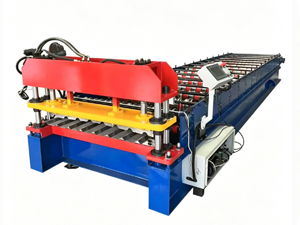
What Is a Roll Forming Machine? A Plain-Language Explanation
You have probably seen the end product of a roll forming machine hundreds of times without knowing it. The corrugated roof on a warehouse. The steel door frame in an office building. The C-section purlin in a factory roof. All of these are roll formed—shaped by passing flat steel strip through a series of rollers that gradually bend it into the finished profile.
Roll forming is one of the most efficient metal fabrication processes in use today. This article explains how it works, why it is so efficient, and what it is used for.
The Basic Idea
Imagine bending a piece of flat steel by hand. You apply pressure at the bend, and the steel curves. Now imagine doing that same bend in very small steps—bending it a little bit at a time, rotating the piece forward slightly between each step, applying the next bend, and repeating. By the time you have done 10 or 20 small bends, you have bent the flat strip into a C-section, a Z-section, or a trapezoidal profile.
That is exactly what a roll forming machine does. Instead of one big bend that stresses and cracks the material, it makes many small bends, each adding a small amount of shaping, until the flat strip becomes the target profile. The process is called "cold" roll forming because it is done at room temperature, without heating the steel.
The Anatomy of a Roll Forming Line
A roll forming line consists of several sections that work together:
Uncoiler: Holds the coil of steel strip and feeds it into the line. The uncoiler applies controlled braking tension so the strip enters the forming section at the right speed and tension.
Entry section (leveller/straightener): Flattens the strip and removes any camber (curvature) before it enters the forming rollers. An unlevelled strip produces out-of-tolerance profiles.
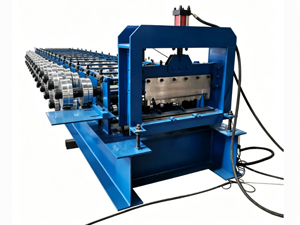
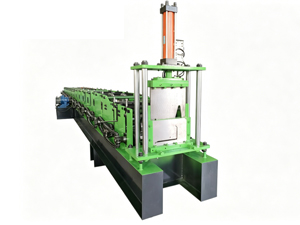
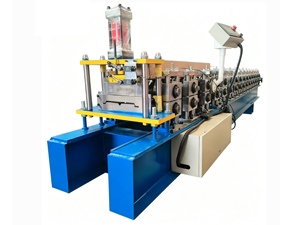
Forming section: The heart of the machine. A series of roller stations, each pair of rollers bending the strip incrementally closer to the target cross-section. Each station adds a small amount of shaping. The number of stations ranges from 6 (simple profiles) to 24 or more (complex profiles or thick material).
Exit section (shear or cutter): Cuts the continuous formed strip to the desired length. Options include fixed shear (stops the line for each cut), flying shear (continues running while cutting, faster for high volume), or saw cutting for thicker materials.
Control system: A PLC (Siemens or Delta are industry standard) controls the line speed, cut length, and machine sequencing. An HMI screen allows the operator to input recipes for different products.
What It Produces
Roll forming produces a very wide range of profiles. The common feature is that they are all open sections—profiles where the cross-section is visible as a single plane, as opposed to closed sections like tubes or boxes which require welding. The most common products include:
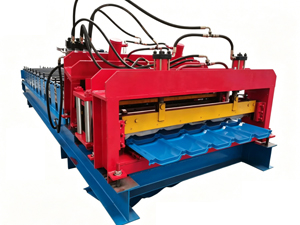
Roof and wall panels: Trapezoidal ribs, corrugated, standing seam, tile-replication profiles
Structural purlins: C-section, Z-section, and hat-section purlins for roof and wall framing
Steel framing: Studs, tracks, and joists for light steel framing systems
Floor decks: Deep-rib profiles for composite steel-concrete floor systems
Door and window frames: Profiles with rabbet steps to receive door and window panels
Roller shutter slats: Interlocking profiles for roller shutter doors
Gutters: K-style, box, and half-round gutter profiles
Furniture and shelving: Light section profiles for storage racking and furniture frames
Why Cold Roll Forming Is Efficient
Speed
A roll forming line runs at 5–20 m/min continuously. For a simple profile on a light-duty machine, that translates to 300–1,200 linear meters of finished profile per hour. No other metal forming process comes close to this throughput for long, constant-section products.
Dimensional Accuracy
Roll formed profiles are dimensionally consistent along their entire length. The rollers determine the profile geometry—once set correctly, every meter of output matches the previous one. Press braking or welding produces profiles that vary from piece to piece depending on the operator and the setup.
Material Utilization
Roll forming uses flat strip as input, with no additional material lost to edge trim or bevelling (beyond any side trimming of the strip itself). Scrap rates are typically under 2%. Press braking from plate or bar produces significantly more waste.
Coating Preservation
Cold roll forming does not heat the material, so the zinc or Galvalume coating on galvanized strip is not damaged during the forming process. The finished profile emerges with its full corrosion protection intact. Welding burns away the zinc at the weld and heat-affected zone, requiring post-weld treatment. This makes roll forming the natural choice for galvanized and Galvalume materials.
What Determines Profile Quality
Roller quality: Rollers made from GCr15 bearing steel at HRC58–62 hold their geometry for millions of linear meters of production. Lower-quality rollers wear faster and lose profile accuracy sooner.
Roller alignment: If the rollers are not precisely parallel and level, the profile will bow, twist, or vary across the width. Regular alignment checks are essential for quality production.
Number of stations: More stations mean more gradual forming, which means less strain at each station, less springback, and better surface quality. Insufficient stations cause cracking and surface defects.
Material consistency: Material batches vary in thickness, yield strength, and coating weight. The machine settings must be adjusted when switching batches. Operators who understand the material behavior—and adjust accordingly—produce better quality than those who run the same settings on every coil.
What Roll Forming Cannot Do
Roll forming is a specialist process, not a universal one. It cannot efficiently produce closed sections (tubes, boxes) without a welding operation. It cannot produce complex three-dimensional shapes or parts with holes and cutouts in the forming stage (holes and cutouts are punched separately, before or after forming). It is not economical for very short production runs—each profile requires a dedicated roller set, and the tooling cost is justified only by sufficient volume. And it cannot form very thick material (above approximately 3–6 mm for most machines) where the forming forces exceed what the machine can deliver.
How Roll Forming Compares to Other Processes
vs. Press braking: Roll forming is faster and more accurate for long, constant-section products. Press braking is more flexible for short runs and varied geometries but is slower and less accurate per piece.
vs. Extrusion: Extrusion forces heated metal through a die—it can produce complex closed sections but requires heating and expensive tooling. Roll forming works at room temperature with simpler tooling.
vs. Hot rolling: Hot rolling produces structural sections at very high volumes and large sizes. Roll forming produces smaller, lighter sections at lower volumes with better dimensional accuracy and coating preservation.
Frequently Asked Questions
Q: What is the difference between roll forming and roll bending?
Roll forming produces a complex cross-sectional profile (ribs, flanges, lips) from flat strip. Roll bending (using a plate roll machine) simply curves flat plate into cylinders or cones—it does not add rib or flange geometry. They are different machines for different purposes.
Q: How fast does a roll forming line run?
Typical speeds are 5–15 m/min for standard roof and wall panels, 8–20 m/min for lighter profiles, and 3–8 m/min for heavy structural profiles or thick material. Flying shear configurations can increase effective throughput by eliminating idle time between cuts.
Q: Can roll forming damage the galvanized coating?
No—cold roll forming does not heat the material, so the zinc or Galvalume coating is preserved. This is one of the key advantages of roll forming over processes that involve heating or welding.
Q: How long do the rollers last?
GCr15 rollers at HRC58–62 typically last 3–8 years depending on production volume and material abrasiveness. Roller replacement is a planned maintenance item, not an emergency.
Conclusion
Roll forming is the most efficient method for producing long, constant-section metal profiles at volume. Its combination of speed, accuracy, material utilization, and coating preservation makes it the dominant production method for roof panels, structural purlins, door frames, floor decks, and dozens of other products in the built environment. Understanding how it works—and what it cannot do—is the foundation for specifying and operating roll forming equipment effectively.
Sources: SME (Society of Manufacturing Engineers) Roll Forming Technical Reference; AISI Cold-Formed Steel Design Manual; ISO 10163:1991 Cold-Rolled Steel Strip — Tolerances on Dimensions and Shape; Machinery's Handbook, 30th Edition, Section on Rolling and Roll Forming Processes.






 首页
首页 产品
产品 联系
联系
