

C Purlin vs Z Purlin: Which Profile Should You Choose?
The Value of Getting the Purlin Profile Right
Specifying the correct purlin profile directly affects material cost, structural stiffness, and erection speed. In a typical portal-frame building, purlins can account for a meaningful share of total steel weight, so small section optimizations compound across the whole roof.
A well-chosen profile also simplifies the connection system. C and Z sections accept different bridging and lap details, and matching the profile to the span reduces the need for intermediate bracing and splice plates.
Structural Differences Between C and Z Purlins
A C purlin has a symmetrical C cross-section, while a Z purlin is asymmetric with the flanges rotated relative to the web. That asymmetry is what allows Z sections to lap neatly into each other at splices.
Because of the symmetry, C purlins resist loads equally in both flange directions, which makes them a safe default for wall girts and bracing. Z purlins, by contrast, are oriented for continuous, same-direction roof loading.
Matching Purlin Profile to Building Application
For continuous roof runs with long spans, Z purlins are usually preferred because their straight lap creates an almost continuous member and saves overlap steel. For walls, mezzanine ledgers, and locations with reversing loads, C purlins are the safer choice.
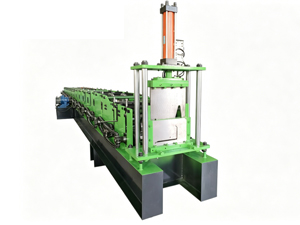
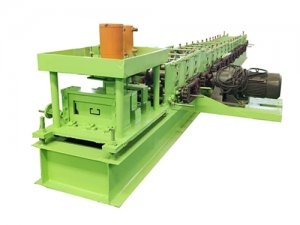
Many fabricators stock both. With a CZ purlin exchangeable machine, one roll forming line switches between C and Z tooling, so a shop can fulfill mixed orders without doubling its equipment investment.
Evaluating Load and Continuity Performance
When spans exceed roughly 7 to 8 meters, the continuous lap of Z purlins begins to outperform overlapped C sections, which otherwise need thicker material or additional sleeves. The Z lap also keeps the top flange aligned, improving bridging seat alignment.
C purlins can still reach long spans, but they typically require sleeve connectors at laps. That adds weld or bolt points and slightly more steel, which should be weighed against the simpler, reversible behavior of the C shape.
Procurement and Machine Verification Standards
When sourcing a purlin roll forming machine, verify the available section sizes, thickness range, and whether the line produces true Z orientation with adjustable lip. Ask the supplier for a sample profile drawing and a rolling tolerance report.
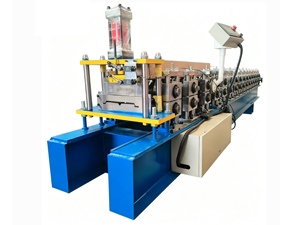
A reliable C purlin roll forming machine should hold web height and lip angle within tight tolerances so that bolts and bridging fit without reaming. Request references from existing steel-building clients before purchase.
Common Pitfalls in Purlin Selection
The first pitfall is mixing C and Z in the same lap without checking flange orientation, which creates a step that traps water and weakens the connection. Keep one profile family per continuous run.
The second is under-specifying thickness to cut cost, then discovering excessive deflection that cracks the roof sheet. Always run the span-and-load check before finalizing the section, rather than copying a neighbor's building.
C Purlin vs Z Purlin: Selection Framework
Use the framework below as a quick decision aid during tendering. For most single-span warehouses, Z purlins win on steel saving; for multi-use frames with walls and bracing, C purlins win on versatility.
| Factor | C Purlin | Z Purlin | Practical Impact |
|---|---|---|---|
| Lap / continuity | Needs sleeve plates | Straight same-direction lap | Z better for long roof spans |
| Load symmetry | Symmetric, reversible | Asymmetric, oriented | C better for walls and bracing |
| Steel saving | More overlap steel | Fewer overlaps | Z reduces total weight |
| Fabrication | Single tooling | Single tooling (exchangeable) | One CZ line serves both |
| Best use | Walls, ledgers, bracing | Continuous roof purlins | Match profile to location |
Frequently Asked Questions
Can C and Z purlins be used together in one building?
Yes, but keep them in separate runs. Use C purlins for walls and bracing and Z purlins for continuous roof lines. Do not lap a C into a Z without checking flange orientation, because the mismatch creates a step and a weak connection.
Which is stronger, C or Z purlin?
Neither is universally stronger. C purlins are symmetric and handle reversing loads well; Z purlins lap into a near-continuous member and perform better on long, same-direction roof spans. Strength depends on section size, thickness, and span.
Do I need two different machines for C and Z purlins?
Not necessarily. A CZ purlin exchangeable roll forming machine uses quick-change tooling to produce both C and Z profiles on one line, which is the most common setup for steel-building fabricators.
What thickness can a CZ purlin machine handle?
Typical lines roll 1.5 to 3.0 mm galvanized or painted coil, though heavy-duty models reach thicker sections. Confirm the exact range with the machine supplier and request a sample profile before ordering.
How do I calculate the purlin size for my building?
Run a span-and-load check using roof dead load, live load, and wind. Most suppliers provide a selection chart, but for large spans engage a structural engineer so deflection stays within code limits.
Is a Z purlin cheaper than a C purlin?
Per meter, Z purlins often use less steel on long continuous roofs because the lap overlap is smaller. The machine cost is similar when you use one exchangeable line, so the saving comes from material, not equipment.
Conclusion
Choosing between C and Z purlins is a balance of span, load direction, and fabrication flexibility. Z sections save steel on long continuous roofs, while C sections remain the versatile choice for walls and bracing.
For fabricators serving mixed projects, a CZ purlin exchangeable machine from Tianyu Machinery is the pragmatic way to produce both profiles on one line. Contact our team to match a purlin roll forming line to your section range and daily output.
next:none





 首页
首页 产品
产品 联系
联系
