

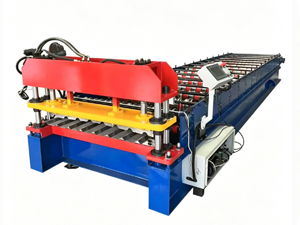
Steel Gutter Roll Forming Machine: Applications and Profile Types for Buildings
Every pitched roof needs a gutter. It is one of the most overlooked components of a building envelope—until it fails. When gutters overflow, leak, or sag, the consequences range from stained walls and damaged foundations to serious structural problems caused by uncontrolled water ingress. Steel gutters, roll formed from continuous coil, offer a durable, precision-made alternative to extruded PVC or site-bent aluminum.
This article covers how steel gutter machines work, the main profile types, their applications, and what to specify for different building types.
Why Steel Gutters?
PVC gutters are the dominant residential product in most markets—they are cheap, lightweight, and easy to install. But PVC has a limited lifespan: it becomes brittle with UV exposure, cracks under thermal stress, and sags under sustained load. A steel gutter, produced from continuous galvanized or Galvalume coil with a factory-applied color coating, typically outlasts the building it serves. The roll forming process produces seamless lengths—no joints except at corners and outlets—eliminating the leak points that plague sectional PVC systems.
Steel gutters are also more resistant to impact damage than PVC and do not soften or deform in high temperatures. For commercial, industrial, and high-end residential applications, steel gutters are the standard specification.
How Gutter Roll Forming Machines Work
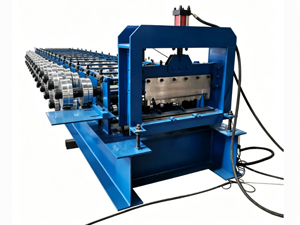
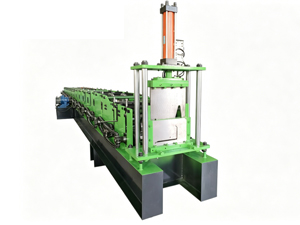
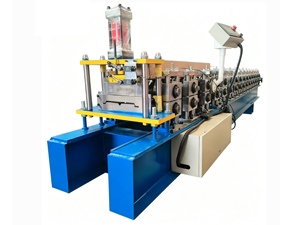
A gutter roll forming machine takes flat steel strip and shapes it into the U-shaped or K-shaped cross-section through a progressive series of bending stations. The process is continuous: a coil feeds in one end, a formed gutter section exits the other, and a flying shear or fixed shear cuts lengths at the exit. The forming process must maintain the tight dimensional tolerances needed to ensure that lengths fit together correctly at joints and that the resulting gutter drains properly when installed.
Standard machine configurations produce gutter widths of 100–250 mm (measured across the top opening) and material thickness of 0.4–0.8 mm. The profile geometry includes the front lip (the curved or angular front face that captures water from the roof), the rear wall (which sits behind the fascia or fix to the roof edge), and the bottom (the channel that carries water toward the outlet).
K-Style Gutters: The Residential Standard
K-style gutters—named because the profile resembles the letter K when viewed from the side—are the most common residential steel gutter profile. They have a flat back that fixes directly to the fascia board, a decorative front face that resembles crown molding, and a curved bottom. K-style gutters handle moderate water volumes, are structurally stiff enough to span between brackets at 600–900 mm spacing, and are widely available in sizes from 100 mm to 150 mm wide.
The K-style profile is produced by rolling a flat strip through 8–12 forming stations that progressively shape the flat strip into the characteristic cross-section. The forming sequence must handle the decorative front face profile without distorting the zinc or coating layer—and this requires adequate roller quality and controlled forming speeds.
Box Gutters: For Commercial and Industrial Buildings
Box gutters are square or rectangular in cross-section and are used on commercial, industrial, and flat-roofed buildings where larger water volumes must be handled. A 200×200 mm box gutter can carry significantly more water than a 150 mm K-style gutter of the same length, making it the appropriate choice for large roof areas and buildings with steep pitches.
Box gutter roll forming is more demanding than K-style because the profile has more complex bends—including internal corners at the bottom and the rear wall. Some box gutter profiles include an internal expansion joint that accommodates thermal movement without distorting the gutter body.
Box gutters are typically used in concealed gutter applications where they are hidden behind a parapet or roof edge, so the external appearance of the gutter itself is less critical than the functional requirement of handling large water volumes.
Half-Round Gutters
Half-round gutters—semicircular in cross-section—are the traditional profile seen on period buildings, churches, and heritage properties. They are less efficient at handling water volume than K-style or box gutters (a semicircle has less cross-sectional area than a rectangle of the same width) but are preferred for aesthetic reasons in conservation and heritage contexts.
Roll forming a true half-round profile requires a different roller geometry to K-style or box profiles. The forming sequence must bend the flat strip into a complete semicircle—which requires more stations than a K-style and careful control of the closing seam at the bottom of the gutter.
Material Choices
Galvalume (AZ150): The preferred substrate for steel gutters in most markets. The zinc-aluminum alloy coating provides excellent corrosion resistance, particularly in coastal and industrial environments. Factory-applied polyester or PVDF color coating over the Galvalume provides the finished appearance.
Galvanized (Z275): Standard galvanized steel is adequate for inland, low-humidity environments. Less resistant to coastal or industrial pollution than Galvalume.
Pre-painted Galvanized (PPGI): A color coating applied at the factory over galvanized or Galvalume substrate. Available in standard RAL colors. The coating system is the same as that used for roof and wall panels.
Aluminum: Lighter than steel, with good corrosion resistance. Less structurally stiff than steel for the same thickness, which means thicker material or additional support brackets are needed. More expensive than galvanized steel in most markets.
Seamless vs Sectional
One of the key advantages of roll formed steel gutters is the seamless length. A continuous gutter run—with no joints except at corners and outlets—eliminates the most common leak point in gutter systems. Sectional gutters (PVC or site-bent aluminum) are joined at each length with a connector bracket and sealant. Over time, these joints work loose, the sealant degrades, and they leak. A seamless steel gutter run, cut to the exact building dimension, has no such joints to fail.
Key Specifications for Gutter Lines
When specifying a gutter roll forming machine, the critical parameters are: maximum gutter width and profile depth the machine can produce, material thickness and grade range, number of forming stations (more stations produce better profile accuracy and surface finish), cutting system (flying shear for high volume, fixed shear for standard production), and whether the machine includes a crimping station for producing the interlocking joints used at corners and outlets.
Applications Across Building Types
Residential pitched roofs: K-style gutters, 100–150 mm wide, fixed to fascia board with bracket hangers
Commercial and industrial buildings: Box gutters or large K-style, 150–250 mm wide, fixed to structural gutters or directly to the building structure
Heritage and conservation buildings: Half-round gutters, fixed with traditional spiked straps or bracket systems
Agricultural buildings: Box gutters for large roof areas, typically in galvanized steel without color coating
Frequently Asked Questions
Q: How do steel gutters compare to PVC in terms of lifespan?
Steel gutters with a factory-applied coating typically last 30–50 years. PVC gutters typically last 10–20 years before significant UV degradation and embrittlement become apparent. The steel gutter's lifespan depends on the coating specification—Galvalume with PVDF coating outperforms galvanized with polyester coating.
Q: Can a gutter roll forming machine produce both K-style and box gutters?
Not on the same roller set. K-style and box gutter profiles have fundamentally different geometries and require separate roller cassettes. Some machines support quick-change cassettes for different profile families, allowing a workshop to switch between K-style and box gutters without buying two machines.
Q: What size gutter do I need for my building?
Gutter sizing depends on roof area, pitch, local rainfall intensity, and the number and location of downpipe outlets. A structural engineer or building regulations official should specify the gutter size for commercial or industrial buildings. For residential applications, 100–125 mm K-style gutters handle most standard pitched roofs in moderate climates; larger sizes are used for steep pitches, large roof areas, or high-rainfall regions.
Q: Are steel gutters noisier than PVC during rain?
Somewhat—a metal gutter resonates more than PVC. In practice, this is rarely a significant complaint for residential installations. For buildings where acoustic performance matters (e.g., buildings with sleeping accommodation directly below the gutter line), an acoustic gasket behind the gutter back wall reduces resonance.
Conclusion
Steel gutters, roll formed from continuous Galvalume coil, provide a durable, seamless, and aesthetically flexible solution for residential, commercial, and industrial buildings. The choice between K-style, box, and half-round profiles depends on water volume requirements, building type, and aesthetic context.
Tianyu manufactures gutter roll forming machines for K-style, box, and half-round profiles, with configurations for material from 0.4 mm to 0.8 mm thickness and widths from 100 mm to 250 mm. Crimping stations for corner joints are available as an option.
Sources: MCA (Metal Construction Association) Metal Roof Systems Design Manual; NRCA (National Roofing Contractors Association) Gutter and Downspout Installation Guidelines; ASTM E1514 Standard Specification for Stainless Steel Roof Drainage Systems; AS/NZS 3500.3:2021 Plumbing and Drainage — Stormwater Drainage.






 首页
首页 产品
产品 联系
联系
