

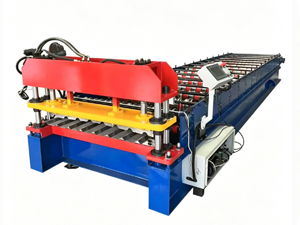
Door Frame Roll Forming Machine: Profile Types and Production Efficiency
Steel door frames are everywhere—commercial buildings, hospitals, schools, industrial facilities, fire-rated stairwells—and yet most people never think about how they are made. The answer is roll forming: continuous steel strip shaped into frame profiles at production speeds that make factory-built steel frames cost-competitive with site-welded or timber alternatives.
This article explains how door frame roll forming machines work, the main profile types, the material specifications, and why roll forming is the dominant production method for steel door frames worldwide.
Why Roll Forming for Door Frames?
The economics are decisive. A roll forming line produces a continuous door frame profile at 8–20 m/min, cutting lengths as they exit the line. The dimensional accuracy of roll formed profiles ensures that frame components—jambs, heads, and thresholds—fit together precisely at mitred or welded joints without requiring extensive fitting work on site. Compared to fabricating door frames from flat bar (cut, bend, weld, grind, paint), roll forming is faster, more accurate, and produces less scrap.
Roll formed door frame profiles also have a clean, sharp geometry that is difficult to achieve with press braking or welding. The formed profile is a single piece—no joints in the frame leg—where a press-braked profile typically has a weld along one corner.
Main Door Frame Profile Types
Double Rabbet Profile
The double rabbet profile is the standard for commercial steel door frames in most markets. The profile has two rabbets (stepped shoulders) on the inside face—one to receive the door leaf on the hinge jamb, and one on the strike jamb to receive the latch. The outside face of the frame is typically flat for a clean reveal against the wall.
The double rabbet geometry requires multiple forming stations to shape both steps correctly. The profile must maintain the rabbet geometry consistently across the full length of each piece—any variation causes fitting problems at the door hinge and strike plate locations.
Single Rabbet Profile
Single rabbet profiles are simpler—only one rabbet step on the frame, typically on the hinge side. Used for pairs of doors where each door leaf is the same size, or for single-door frames where the strike is on the same side as the hinges. Less common than double rabbet but simpler to form.
Flat Profile (Stop Frame)
A flat profile with a weather stop or door stop strip formed on the inside face. Used for exterior door frames where a weather seal against the door leaf is required. The stop strip is either formed as part of the profile (single-piece construction) or welded to the flat profile as a separate strip (two-piece construction).
Adjustable Profile
Adjustable door frames are designed to accommodate a range of wall thicknesses. The frame has a telescoping or clip-fastened adjustment section that allows the frame to be sized on site to fit walls from, for example, 100 mm to 200 mm thick. Adjustable frames add complexity to the forming process—they typically require two forming lines or additional operations—but they significantly reduce the inventory of fixed-size frames that a manufacturer needs to hold.
The Forming Process
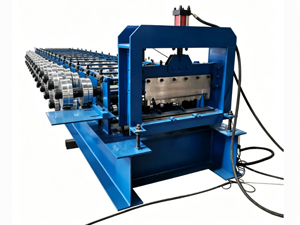
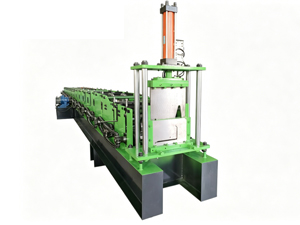
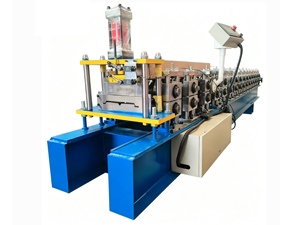
A door frame roll forming machine takes flat galvanized steel strip—typically 0.8–1.5 mm thick—and progressively bends it into the target profile through 12–20 forming stations. The number of stations depends on the profile complexity: a simple flat stop frame requires fewer stations than a double rabbet profile with multiple steps.
The critical parameters in door frame forming are: profile width tolerance of ±0.5 mm (frame components must fit together at mitres), surface quality—scratches or roller pickup on the visible face are unacceptable on pre-finished frames, and consistency of the rabbet geometry—the rabbet step must be the same depth and width at every point along the length.
GCr15 rollers at HRC58–62 on shafts of Ø70–90 mm are standard for door frame production lines, maintaining geometry accuracy over long production runs.
Material Specifications
Door frames are typically produced from galvanized steel (Z275 or Z350) with a nominal thickness of 0.9–1.2 mm for standard commercial frames and 1.2–1.5 mm for heavy-duty or security frames. The thickness is significantly heavier than typical roof or wall panels because the frame must resist door hardware loads (hinge screws, strike plate screws) without pulling out of the frame wall.
Pre-painted galvanized steel (PPGI) with polyester or PE coating is standard for factory-finished frames—the frame arrives at site with a factory-applied coating that requires no painting. For fire-rated door frames, the material and coating specifications must comply with the applicable fire test standard (EN 16034 in Europe, UL 10B/UL 10C in the United States).
Production Efficiency: Roll Forming vs Other Methods
Compared to press braking flat bar: roll forming produces a single-piece profile with no weld in the frame leg. Press braking requires a weld along the inside corner, which must be ground smooth and sealed against corrosion. Roll forming eliminates this step entirely.
Compared to tube fabrication: rectangular hollow section (RHS) can be cut and mitred to form door frames, but RHS is significantly more expensive than flat strip, and the mitred and welded joints require grinding and sealing that roll formed profiles do not need.
Compared to timber: steel door frames are straighter, more dimensionally stable (timber warps), stronger at the hardware fixings, and do not rot. Steel frames are standard for commercial, institutional, and high-traffic residential applications in most markets.
Key Features of Door Frame Production Lines
Flying shear or fixed shear: Fixed shear stops the line for each cut; flying shear continues production during cutting and is preferred for high-volume production.
Automatic packing or stacking: Some lines include automatic stacking of cut frame lengths for handling efficiency and reduced labor.
Pre-punching stations: Hinge cutouts, strike plate cutouts, and fixing hole punching can be integrated into the forming line, eliminating a separate fabrication operation.
Profile quick-change: Different frame profile widths (for different door sizes) may be accommodated via quick-change cassettes or adjustable side guides, reducing changeover time between runs.
Applications for Roll Formed Steel Door Frames
Commercial and institutional buildings—offices, hospitals, schools, government facilities
Fire-rated stairwell and compartment doors—fire-rated frame specification required
Industrial facilities—heavy-traffic doors, security-rated doors, clean room doors
Multi-unit residential buildings—corridor and apartment entrance doors
Exterior entrances—weatherproof frames with thermal break for heated buildings
Frequently Asked Questions
Q: What thickness steel is used for door frames?
Standard commercial frames: 0.9–1.2 mm galvanized steel. Heavy-duty or security frames: 1.2–1.5 mm. The frame must be thick enough to hold hinge and strike plate screws securely—thinner material strips out under hardware loading.
Q: Can roll formed door frames be used for fire-rated doors?
Yes—roll formed steel frames are routinely used in fire-rated door assemblies. The frame must be tested and certified as part of the complete fire door assembly (door leaf, frame, hardware, and glazing where applicable) under the applicable fire test standard.
Q: How long can a roll formed door frame piece be?
Virtually unlimited—the roll forming process is continuous. Typical frame piece lengths for standard doors are 2,100–2,400 mm for jambs and 900–1,200 mm for heads. Long continuous lengths are cut to order at the exit shear.
Q: Are roll formed door frames pre-painted?
Yes—in most markets, factory-finished frames with a pre-applied polyester or PE coating are standard. The factory finish eliminates site painting, ensures consistent quality, and speeds up the installation process.
Conclusion
Door frame roll forming is a high-volume, precision production process that produces dimensionally accurate, pre-finished steel frame components at a cost and speed that alternative fabrication methods cannot match. The profile types—double rabbet, single rabbet, and flat stop—serve different door specifications, and the forming tolerances ensure that frame components fit together precisely at joints and hardware locations.
Tianyu manufactures door frame roll forming machines configured for double rabbet, single rabbet, and flat stop profiles, with integrated pre-punching stations and automatic stacking options. Share your frame profile drawing and material specification for a tailored configuration proposal.
Sources: EN 16034:2014 Pedestrian Door Sets — Fire-Resisting and/or Smoke Control Characteristics; UL 10B Fire Tests of Door Assemblies; Steel Door and Frame Manufacturers Association (SDI) Standards for Steel Doors and Frames; BHMA (Builders Hardware Manufacturers Association) A156.8 for door controls and hardware preparation.






 首页
首页 产品
产品 联系
联系
