

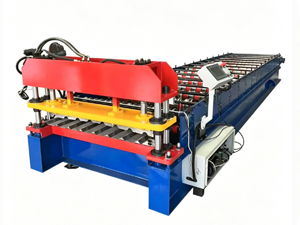
Hidden Roof Panel Roll Forming Machine: Concealed Fastener Roofing Systems and Factory Manufacturing
Concealed fastener roofing panels represent one of the most significant advances in metal roof design over the past half-century. By hiding the fasteners that attach panels to the structural substrate, these systems eliminate the primary failure point in metal roofing—the exposed screw hole that eventually leaks as sealants degrade, washers compress, or metal expands and contracts around the fastener. Hidden roof panel roll forming machines produce the profiles that enable this performance advantage, and understanding how these machines work helps factories make informed decisions about equipment and market positioning.
The Concealed Fastener Advantage
Traditional exposed fastener metal roofs—often called "through-fastened" systems—secure each panel with screws that penetrate the panel and the structural substrate. These fasteners perform reliably for 10 to 15 years in ideal conditions, but in demanding environments, fastener failure can begin within 5 to 7 years. The failure mechanism involves galvanic corrosion between the dissimilar metals of fastener and panel, washer deterioration from UV exposure, and the natural thermal cycling that loosens threaded fasteners over thousands of temperature cycles.
Concealed fastener systems solve this problem by eliminating the penetrations through the weather surface of the panel. The fastener attaches to the structural substrate through a slot in the female rib of the panel, and a separate male rib overlaps to cover the fastener once installed. The result is a weatherproof surface with no penetrations through the standing seam or rib.
The performance benefit translates directly to maintenance cost savings and extended roof service life. A properly installed concealed fastener roof regularly achieves 25 to 30 years of maintenance-free service, compared to the 10 to 15 years typical for exposed fastener systems.
Panel Profile Geometry
Hidden roof panels incorporate specific profile features that enable the concealed attachment while maintaining weatherproofing performance. The female rib typically incorporates a vertical leg with a return edge that engages the male rib from an adjacent panel.
The attachment slot in the female rib allows the fastener to pass through while the rib still covers the penetration point. The slot must be wide enough to allow thermal movement of the panel relative to the fastener, preventing the binding that would cause oil canning or rib distortion.
Common panel widths range from 300mm to 500mm, with the narrower widths providing more structural ribs for higher wind load conditions. The rib height typically measures 38mm to 50mm, providing water-shedding capacity and the visual shadow line that defines the architectural character of concealed fastener roofs.
Roll Forming Machine Requirements
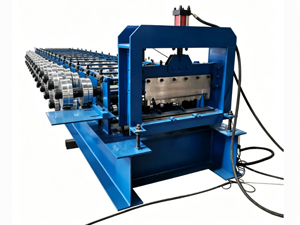
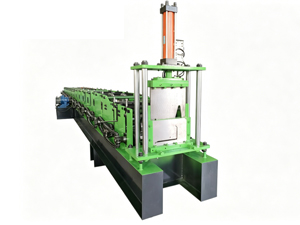
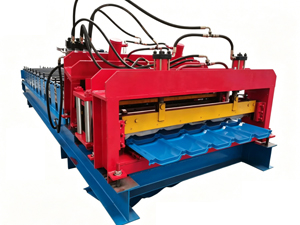
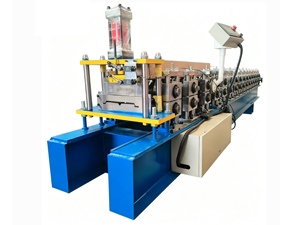
Producing concealed fastener panels requires roll forming machines with specific capabilities beyond those needed for standard trapezoidal roof sheets. The rib geometry—including the attachment slot and the interlocking return edges—demands precise roller design and manufacturing.
Roller precision becomes critical because any dimensional variation in the rib geometry affects how panels interlock and whether the male rib fully engages the female rib without gaps. Quality concealed fastener roller sets require tighter manufacturing tolerances than standard profile rollers, and the roller material must resist wear that would gradually alter the profile geometry over thousands of meters of production.
The forming sequence for concealed fastener panels typically involves 10 to 16 roller stations, with the final stations dedicated to shaping the interlocking rib geometry. Running speeds are typically lower than standard roof sheet machines—10 to 25 meters per minute—because the tighter bends in the rib profile require more gradual forming to avoid cracking paint coatings.
Material Selection for Concealed Fastener Panels
Galvalume steel represents the dominant substrate choice for concealed fastener panels in most markets. The aluminum content provides excellent atmospheric corrosion resistance while maintaining good paint adhesion for pre-finished products. Coating weights of AZ150 to AZ200 are standard for most construction applications.
Thickness range spans 0.45mm to 0.70mm for most concealed fastener profiles. Thicker material provides better dent resistance and structural performance but increases forming forces and material costs. The appropriate thickness depends on the structural support spacing and anticipated wind loads.
Pre-painted finishes with PVDF (polyvinylidene fluoride) or SMP (silicone-modified polyester) coating systems provide the longest service life and best color retention. These factory-applied finishes achieve 25 to 35-year warranties and maintain their appearance through decades of weather exposure.
Installation Methods and System Design
Concealed fastener panel installation follows systematic procedures that factories should understand when developing technical documentation for their products. The attachment clips—either fixed or sliding depending on thermal movement requirements—attach to the structural substrate first, followed by panel installation from the eave upward.
Each panel engages the previously installed panel's female rib with its male rib, then the male rib of the next panel engages the female rib of the installed panel. The attachment fastener passes through the slot in the female rib into the clip and substrate below.
For projects in high-wind zones or with low-slope conditions, factories should specify mechanically seamed versions of their concealed fastener profiles, where the overlapping ribs receive a final seaming pass that creates a tighter, higher-strength joint.
Quality Assurance for Panel Production
Concealed fastener panels require tighter quality control than exposed fastener alternatives because dimensional errors that might be acceptable in a through-fastened panel become critical in a concealed system. The interlocking geometry provides no adjustment range once panels are mated—if the male rib is too narrow, it will not engage the female rib; if too wide, it will not close properly.
Essential quality checks include rib height consistency (targeting ±0.3mm tolerance), rib angle consistency (targeting ±1 degree tolerance), panel width consistency, and straightness verification over full panel lengths.
Interlock testing—engaging sample panels and verifying the joint closes properly—provides confidence that the production output will install correctly. Many quality-focused factories run this test on every production batch.
Applications Across Building Types
Concealed fastener roofs serve diverse building applications:
Commercial and industrial buildings—warehouses, factories, and distribution centers—benefit from the low maintenance requirements and long service life, reducing lifecycle costs for building owners.
Institutional buildings including schools, hospitals, and government facilities specify concealed fastener roofs for their durability and consistent appearance over decades.
Agricultural buildings—barns, storage facilities, and livestock housing—increasingly adopt concealed fastener profiles where the improved weatherproofing and reduced maintenance justify the higher material cost.
Residential construction in some markets has embraced concealed fastener metal roofing for its contemporary aesthetic and storm resistance, particularly in coastal and high-wind regions.
Business Development for Hidden Panel Manufacturers
Fatories entering the concealed fastener panel market should focus on establishing relationships with roofing contractors who install these systems. Technical competence and product documentation differentiate professional suppliers from commodity traders.
Providing comprehensive technical data—including load tables for different structural support spacings, installation details for edge conditions, and thermal movement calculations—supports the specification process and builds confidence in your product.
Warranty programs that cover both material performance and installation (when your trained installers perform the work) command premium pricing and create customer loyalty.
References
Metal Construction Association. Performance Standards for Concealed Fastener Metal Roof Panels. MCA Publication 2019-2. MCA, 2019.
National Roofing Contractors Association. Metal Panel Roof Systems Manual. NRCA, 2022.
American Society of Civil Engineers. ASCE 7-22: Minimum Design Loads and Associated Criteria for Buildings and Other Structures. ASCE, 2022.
Sheet Metal and Air Conditioning Contractors National Association. HVAC Duct Construction Standards — Metal and Flexible. SMACNA, 2020.
Roofing Consultants Institute. Metal Roofing: A Practical Design Guide. RCI, 2021.






 首页
首页 产品
产品 联系
联系
