

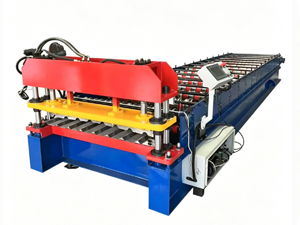
Hydraulic Uncoiler for Roll Forming Lines: Types, Specifications and How to Choose
The decoiler is the unsung hero of any roll forming line. It sits at the entry end of the line, holds the coil, and feeds strip into the forming stations at a controlled speed and tension. Get it right and the forming line runs smoothly. Get it wrong—coil slipping, mandrel misalignment, insufficient tension control—and the production line becomes a constant source of stoppages, material waste, and operator frustration.
This guide covers the types of decoilers available, how to select the right capacity, and the key specifications that determine whether a decoiler will integrate well with your roll forming line.
What Does an Uncoiler Do?
An uncoiler performs three functions simultaneously during production:
Coil holding: The decoiler holds the coil securely on a mandrel that expands to grip the inner diameter of the coil. The coil must be held firmly enough that it does not slip during feeding but not so tightly that it deforms the inner wraps.
Controlled strip feeding: The decoiler feeds strip into the forming line at the same speed as the line's forming speed. If the decoiler feeds too fast, the strip buckles; too slow, it stretches and thins. The decoiler's brake system controls this tension.
Tension control: The strip must be maintained under consistent tension from the decoiler through to the exit shear. Too much tension and the strip thins or tears; too little and it buckles. The decoiler's braking system is the primary tension control device.
Manual vs Hydraulic vs Motorized Decoilers
Manual Decoilers (Plain Expander)
A manual decoiler uses a mechanical expanding mandrel that the operator expands by hand using a wrench or lever. The operator also manually adjusts the brake band tension to control strip feeding. Manual decoilers are suitable for low-volume production, light coils (up to 3 tonnes), and operations where the operator is always present at the machine. They are the lowest-cost option and remain common in small fabrication shops. The limitation is operator dependency—consistency depends on the operator's skill and attention, and changing coil size requires manual adjustment each time.
Hydraulic Decoilers
A hydraulic decoiler uses a hydraulic cylinder to expand the mandrel, operated by a simple lever or valve. The brake system is also hydraulic—pressure-adjusted to control strip tension. Hydraulic decoilers handle heavier coils (5–15 tonnes), support faster coil changes, and provide more consistent tension control than manual systems. They are the standard specification for medium-to-high volume roll forming operations. The hydraulic system provides smooth, adjustable tension control and handles the shock loads that occur when a new coil is started.
Motorized (Active) Decoilers
A motorized decoiler has an electric motor driving the mandrel, so the decoiler actively feeds the strip rather than simply releasing it under brake tension. This provides the most precise tension control of any decoiler type and is used for high-speed production lines, precision-critical applications, and lines running pre-painted or sensitive coated materials where tension spikes can damage the coating. Motorized decoilers are more expensive but offer the best production performance.
Key Specifications to Select Correctly
Maximum Coil Weight (Tonnage)
The decoiler must be rated for the heaviest coil you intend to run. Coil weight is calculated from the coil's outer diameter, inner diameter, width, and material thickness. For standard galvanized coil at 0.5 mm thickness and 1,200 mm width, a 5-tonne coil has an outer diameter of approximately 1,200 mm; a 10-tonne coil approximately 1,600 mm. Always size the decoiler for the heaviest coil you will realistically receive—not the average.
Coil Inner Diameter (ID)
Standard mandrel IDs are 508 mm (20 inches) and 610 mm (24 inches). These are the most common worldwide. Some markets use 406 mm (16 inches) or 710 mm (28 inches). Always match the mandrel ID to your actual coil supply—the mandrel cannot be changed without replacing the whole unit.
Coil Width Range
The decoiler's coil guide arms must accommodate your widest coil. A decoiler with a maximum width of 1,250 mm cannot run a 1,400 mm wide coil. Check the coil width range and ensure it covers your material supply.
Expansion Range
The mandrel must expand from the minimum to the maximum inner diameter you intend to run. For example, a mandrel that expands from 480 mm to 520 mm can only handle 508 mm ID coils. A mandrel that expands from 460 mm to 620 mm can handle both 508 mm and 610 mm ID coils—a flexibility advantage if you receive coils from multiple suppliers.
Brake Type and Control
Most decoilers use a spring-applied, hydraulically released brake—the spring applies tension, and the hydraulic system releases it. This is fail-safe: if hydraulic pressure is lost, the brake applies automatically, stopping the coil. Confirm the brake torque capacity is adequate for your line speed and material tension requirements. Pneumatic brakes are an alternative in some markets but require a compressed air supply.
Integration with the Roll Forming Line
The decoiler is the first machine in the line, but it must operate in coordination with everything downstream. The key integration points are:
Line speed synchronization: The decoiler's braking system must maintain consistent strip tension at the entry speed of the forming line. If the line speed changes (for example, when running different profiles or thicknesses), the brake torque must adjust accordingly. Modern roll forming lines with Siemens or Delta PLC can provide a brake torque signal based on line speed, which maintains tension automatically across speed changes.
Loop control: A loop pit or loop accumulator between the decoiler and the first forming station provides a buffer of excess strip that prevents tension variations from the decoiler reaching the forming stations. Without loop control, every start-stop of the decoiler transmits directly to the forming section. Even a small loop (300–500 mm) significantly smooths tension fluctuations.
Entry guide alignment: The strip must enter the first forming station square and centered. An entry guide or strip accumulator on the decoiler outlet corrects any coil camber (lateral drift of the strip edge as it unrolls) before the strip reaches the forming section.
Safety Considerations
Coils are heavy objects under significant stored energy—tens of tonnes of steel wound tightly. A coil that escapes from a decoiler or mandrel is a serious safety incident. Ensure the decoiler includes: a mechanical mandrel lock that prevents the mandrel from collapsing if hydraulic pressure is lost, adequate coil retention clamps that hold the outermost wraps securely before the mandrel is removed, and safety barriers around the decoiler area to protect operators from the coil's outer circumference during rotation.
Frequently Asked Questions
Q: Can I run 508 mm ID and 610 mm ID coils on the same decoiler?
Only if the mandrel has an expansion range that covers both IDs. A mandrel that expands from 460 mm to 620 mm will grip both IDs with the appropriate adapter or adjustment. Confirm the expansion range covers both IDs before ordering.
Q: What happens if I order a decoiler rated for 5 tonnes but receive a 7-tonne coil?
You cannot safely run the heavier coil on an undersized decoiler. The mandrel, bearings, and brake are all rated for the specified weight. Overloading risks mandrel collapse, bearing failure, and uncontrolled coil release. Always size the decoiler for the heaviest coil you will realistically receive.
Q: What is the difference between a decoiler and an accumulator?
A decoiler holds and feeds the coil. An accumulator stores excess strip length between the decoiler and the forming section, allowing the line to continue running briefly while the decoiler is being loaded with a new coil. A loop pit or loop tower is the simplest accumulator type.
Q: How do I prevent coil camber from causing strip tracking problems?
Use an entry guide between the decoiler and the first forming station. The guide corrects lateral drift of the strip edge. If camber is severe (more than 3–5 mm drift per meter), the coil itself may be poorly wound—check the supplier and reject coils with severe camber, as this cannot be fully corrected by a guide.
Conclusion
The decoiler is not an accessory—it is a critical component of the production line that determines uptime, material utilization, and operator safety. Sizing it correctly for maximum coil weight, ID range, and width, specifying the right brake system, and ensuring proper integration with the roll forming line's PLC and loop control will pay dividends in smooth production from day one.
Tianyu manufactures hydraulic uncoilers in capacities from 3 tonnes to 20 tonnes, with configurations for 508 mm and 610 mm mandrel IDs and a coil width range up to 1,500 mm. Decoilers are available as standalone units or integrated into complete roll forming lines with PLC coordination.
Sources: SME (Society of Manufacturing Engineers) Roll Forming Technical Guide; Machinery's Handbook, 30th Edition; ISO 10721-1:2005 Steel Sheet for Cold-Formed Sections; EN 10142:2000 Low Carbon Steel Sheet for Cold Forming — Tolerances on Dimensions and Shape; EU Machinery Directive 2006/42/EC for machine safety.






 首页
首页 产品
产品 联系
联系
