

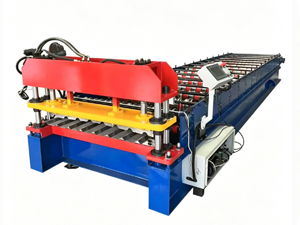
Keel Frame Roll Forming Machine: Light Gauge Steel Construction Applications and Production Insights
The light gauge steel frame has quietly become one of the most widely used structural systems in modern construction. Behind every partition wall, suspended ceiling grid, and interior framing component in countless commercial and residential buildings sits a network of thin-walled steel sections produced by keel frame roll forming machines. This article examines how these machines work, what factories need to consider when setting up or upgrading a keel frame production line, and how the market for light gauge steel structures continues to expand across global construction sectors.
Understanding Keel Sections in Light Gauge Steel Construction
A keel section refers to the C-shaped or U-shaped thin steel profile used in light gauge steel framing. The terminology varies by region: European and Asian markets commonly call them "keel" or "stud" sections, while North American builders refer to them as "steel studs." Despite the regional naming differences, the function remains consistent—these sections form the vertical studs and horizontal tracks that create interior partition walls, ceiling suspension systems, and non-structural framing in low-rise buildings.
The key advantage of light gauge steel framing lies in its combination of strength-to-weight ratio and dimensional precision. A 75mm deep keel section with 0.6mm thickness can span 3 to 4 meters as a non-structural partition wall stud while weighing less than 2 kilograms per linear meter. The consistent cross-sectional dimensions produced by a keel frame roll forming machine mean that builders can design and specify framing layouts with confidence, knowing that every section will fit together without the measurement variations that plague timber framing.
How Keel Frame Roll Forming Machines Operate
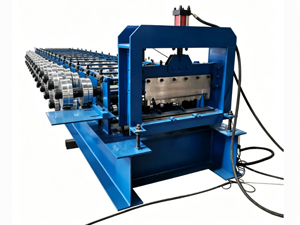
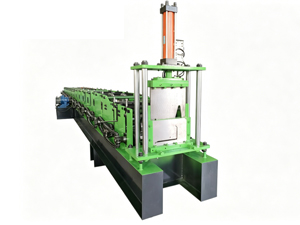
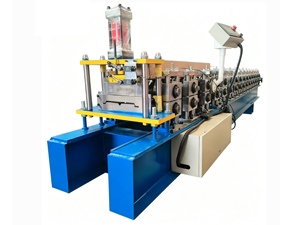
The production process for keel sections shares fundamental principles with other roll forming operations but includes specific features designed for thin-gauge, high-speed production. A typical keel frame roll forming line starts with a decoiler feeding galvanized steel coil into the main forming section, where pairs of rollers progressively shape the flat strip into the desired profile geometry.
What distinguishes keel section production from structural purlin forming is the emphasis on speed and surface quality. Keel sections typically run at material thicknesses between 0.4mm and 1.2mm, with widths from 50mm to 150mm. The forming process must maintain consistent dimensions across thousands of linear meters per shift while preserving the galvanized coating integrity on pre-painted or mill-finished coil.
Modern keel frame machines from established manufacturers incorporate PLC-controlled cutting systems that slice sections to length without stopping the strip. Flying shear technology allows continuous production at speeds up to 60 meters per minute on lighter gauge material, significantly improving throughput for high-volume factories serving large-scale commercial interior fit-out projects.
Profile Options and Customization Capabilities
Factories supplying the light gauge steel market need flexibility in their keel section offerings. A single project may require multiple section depths and flange widths to accommodate different wall configurations, acoustic requirements, and service void dimensions. A quality keel frame roll forming machine should accommodate at least three or four standard profile configurations through interchangeable roller cassettes.
Common keel section types include:
Track sections (U-shape) form the top and bottom horizontal members that receive the vertical studs. These require a flat web with inward-facing flanges designed to accept fasteners through the stud web.
Stud sections (C-shape) form the vertical framing members. The open flange design allows wiring and plumbing services to pass through the wall cavity.
Furring channels provide the attachment surface for plasterboard or other wall linings. These lighter sections often run at higher speeds than structural studs.
Junction and corner sections serve specific architectural detailing requirements and typically represent smaller production volumes but higher margins.
Material Selection for Keel Section Production
The steel grade and coating specification directly affect both the structural performance of the finished sections and the production efficiency of the roll forming line. Most keel section manufacturers specify continuous galvanized (CZ) steel with zinc coating weights of Z100 to Z275 for standard interior applications. The zinc layer protects the underlying steel from corrosion during storage, handling, and the cutting operations that occur on site.
For humid environments or applications where the framing may be exposed to moisture—such as bathroom partition walls, basement ceilings, or exterior stud framing in mild climates—galvalume-coated steel (aluminum-zinc alloy) provides superior corrosion resistance. The aluminum content creates a more stable oxide layer that resists the "white rust" formation common on heavily galvanized sections stored in damp conditions.
Pre-painted steel coil offers factories the ability to supply sections with factory-applied finishes that eliminate the need for on-site painting. This appeals to architects and developers seeking consistent color-matched framing components for exposed ceiling or partition installations in retail and hospitality projects.
Supply Chain Considerations for Keel Section Factories
A keel frame production line requires reliable access to suitable steel coil in the widths, thicknesses, and coatings demanded by the local market. For factories in regions with limited domestic steel production, importing coil from major mills in China, South Korea, or Japan represents the practical supply option. Working with an experienced steel supplier who understands the tolerances required for roll forming—particularly the importance of strip camber, edge camber, and thickness uniformity—prevents production quality issues that waste material and damage tooling.
Finished keel sections present logistical challenges due to their length and relative fragility. Sections typically ship in bundles of 10 to 50 pieces, banded and wrapped for protection during transit. For export-oriented factories, section length is constrained by container dimensions; standard 20-foot containers accommodate sections up to 5.8 meters in length, while 40-foot containers allow sections up to 11.8 meters when oriented diagonally.
Target Markets and Application Sectors
The demand for light gauge steel framing tracks closely with commercial construction activity, interior fit-out specifications, and renovation projects. Key market segments include:
Commercial interior partitions in office buildings, retail spaces, and hospitality venues form the largest single application. The speed of steel frame installation compared to masonry or timber drives specification by contractors working to tight project schedules.
Residential construction in some markets has adopted steel framing for interior walls and roof trusses, particularly in multi-story apartment and hotel projects where the lightweight nature of steel reduces foundation loads.
Renovation and space division projects frequently specify steel stud framing because the sections can be installed without the wet trades, noise, and disruption associated with brick or block construction.
Industrial mezzanine floors and access platforms utilize heavier gauge keel sections as secondary structural members, often with hot-dip galvanized finish for corrosion protection.
Quality Control Standards for Keel Section Production
Factories supplying keel sections to construction projects should understand and comply with relevant national and international standards for light gauge steel framing. Key parameters include dimensional tolerances for section depth, flange width, web flatness, and flange angle. Twist and bow tolerances ensure that sections remain straight and aligned during installation.
Established manufacturers typically implement in-line quality monitoring systems that measure section dimensions during production, alerting operators to deviations before out-of-tolerance material accumulates. Periodic sampling and testing of section mechanical properties—particularly the compressive strength and deflection behavior of assembled wall panels—provides confidence that the supplied sections will perform as specified.
Investment Outlook for Keel Frame Production
The light gauge steel framing market benefits from fundamental construction trends: urbanization, the growth of the commercial interior fit-out sector, and increasing preference for faster, cleaner construction methods. For factories considering keel frame roll forming equipment, the market outlook in most developing and emerging economies appears favorable.
A mid-range keel frame roll forming line suitable for a factory entering this market typically costs between $15,000 and $35,000, depending on the profile range, speed capability, and automation level. Combined with decoiler, electrical, and installation costs, a complete production setup may require $25,000 to $60,000 in capital investment. For factories with existing roll forming capability, adding keel section production represents a logical product diversification strategy with relatively modest incremental investment.
References
American Iron and Steel Institute. Code of Standard Practice for Cold-Formed Steel Structural Framing. AISI S202-20. AISI, 2020.
Steel Construction Institute. Light Steel Framing in Residential Construction: Design Guide. SCI Publication P365. Ascot: SCI, 2019.
British Standards Institution. BS EN 1993-1-3: Eurocode 3: Design of Steel Structures — Cold-Formed Thin Gauge Members and Sheeting. BSI, 2006 with amendments.
International Code Council. Standard for Cold-Formed Steel Framing — Prescriptive Method for One- and Two-Family Dwellings. ICC-400. ICC, 2021.
World Steel Association. Market Development: Light Gauge Steel Framing in Emerging Economies. World Steel Construction Review, 2022.






 首页
首页 产品
产品 联系
联系
