

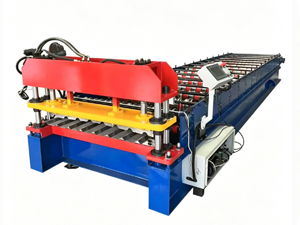
Angle Frame Roll Forming Machine: Steel Angle Production for Construction and Structural Applications
L-shaped steel angles appear throughout the built environment in roles large and small. They frame windows and curtain walls, brace structural frames, support shelving systems, and form the transition details where walls meet floors and ceilings. While hot-rolled angles dominate structural engineering applications, cold-formed steel angles produced on angle frame roll forming machines serve the vast majority of light construction, industrial, and architectural applications. This article examines how factories produce these versatile profiles, what specifications matter for different applications, and how the market for cold-formed angles continues to grow.
Cold-Formed vs. Hot-Rolled Steel Angles
Understanding the distinction between cold-formed and hot-rolled angles clarifies when each product category applies. Hot-rolled angles emerge from the steel mill as molten metal rolled between heavy forming tools and cooled naturally. This process creates sections with consistent material properties throughout and tight dimensional tolerances on the as-rolled geometry.
Cold-formed angles result from shaping flat steel strip through roll forming equipment at ambient temperature. The cold working process increases yield strength through strain hardening but can introduce residual stresses that affect performance in some structural applications. The economic advantage of cold forming—using less material and less energy than hot rolling—makes it the preferred process for most construction and industrial applications below the threshold where hot-rolled sections are required.
For the majority of construction metalwork—window frames, partition supports, shelving, brackets, and architectural trim—cold-formed angles provide adequate strength with better material efficiency and lower cost than hot-rolled alternatives.
Profile Geometry and Dimensions
Steel angles are defined by three key dimensions: the leg widths (two legs of potentially different widths) and the thickness. A standard equal angle has two legs of the same width, while an unequal angle has legs of different widths.
Common equal angle sizes range from 20mm by 20mm by 1.5mm up to 100mm by 100mm by 6mm, depending on the machine capacity and market requirements. Unequal angles typically specify combinations like 50mm by 30mm or 75mm by 50mm, with thickness appropriate to the load requirements.
The corner radius—where the two legs meet—affects both the geometric accuracy of nested assemblies and the structural performance of the section. Hot-rolled angles have substantial corner radii from the rolling process; cold-formed angles can achieve tighter corners but may exhibit greater local stress concentration at the bend location.
How Angle Frame Roll Forming Machines Work
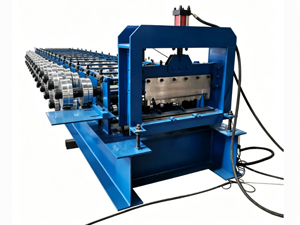
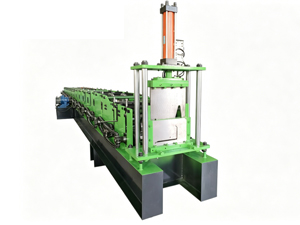
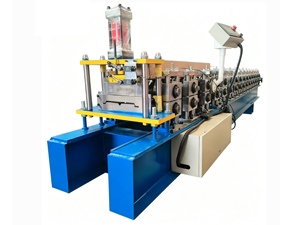
Angle roll forming machines shape steel strip into L-profiles through progressive bending operations. The forming sequence requires rollers that bend the strip in one direction at a time, gradually forming the first leg, then the second leg, while maintaining the perpendicular relationship between legs that defines an angle section.
The key mechanical challenge is maintaining consistent leg angles as the strip transitions through the forming sequence. If the forming force distribution is uneven, the legs may twist or the angle may vary along the strip length. Quality machines from established manufacturers incorporate adjustable roller positions that allow fine-tuning of the forming geometry.
Material thickness for angle section production typically spans 1.0mm to 5.0mm, with lighter gauges (1.0mm to 2.0mm) serving architectural and non-structural applications and heavier gauges (2.5mm to 5.0mm) serving structural and industrial applications. The machine capacity and roller strength must match the thickness and width requirements of the target product range.
Material Selection Considerations
The steel grade selected for angle production affects both the forming process and the performance of the finished section. Most cold-formed angle sections use structural-grade steels with minimum yield strengths of 250 MPa to 350 MPa.
Galvanized steel represents the dominant substrate for construction applications, providing corrosion resistance that extends service life without additional surface treatment. The zinc coating weight (typically Z100 to Z275) should match the anticipated exposure conditions.
Pre-painted galvanized steel enables factories to supply color-matched angles that integrate with architectural metalwork systems. The paint system must tolerate the bending deformation at the angle corner without cracking or delamination.
Finishing and Secondary Operations
Angle sections as formed typically receive one or more secondary operations before reaching their final application:
Cutting to length using saws or shears creates finished pieces from the continuous formed strip. For high-volume production, automated cutting systems with programmable lengths improve efficiency.
Punching and notching create holes for fasteners, clearance for wiring or piping, and geometric features for assembly. A punching station integrated into the roll forming line eliminates a separate fabrication step for standard hole patterns.
End machining—drilling, countersinking, or tapping—forcreates fastener attachment points for precision assemblies. This secondary operation typically occurs at dedicated machining centers rather than on the roll forming line.
Welding preparation, including beveling and back-gouging marks, enables factory or field welding of angle sections into complex assemblies. Proper weld prep affects both the strength and appearance of the final weld.
Common Applications in Construction
Window and curtain wall frames utilize angle sections as perimeter frames, glazing pocket retainers, and thermal break spacers in aluminum systems. The precision and surface quality of cold-formed angles meet the tight tolerances that contemporary window systems require.
Structural bracing frames employ angle sections in X-bracing and knee-bracing configurations where the angle's eccentric geometry provides efficient load paths. Cold-formed angles in these applications must meet structural design requirements.
Industrial shelving and storage systems rely on cold-formed angles as uprights and beam connections. The adjustability of bolt-together angle-based shelving systems creates flexible storage configurations.
Architectural metalwork—including handrails, canopies, and decorative features—frequently specifies cold-formed angles as primary structural elements or mounting substrates. The ability to specify custom dimensions and finishes enables architectural expression.
Mechanical and electrical support systems use angle sections as support brackets, conduit clamps, and equipment mounting frames. The fabrication versatility of angles accommodates the irregular layouts common in MEP installations.
Quality Standards and Specifications
Construction applications for steel angles may be subject to building code requirements or specification standards that define minimum performance criteria. Key standards include dimensional tolerances, mechanical properties, and surface quality requirements.
Dimensional tolerances typically cover leg width variation (±1mm or ±2mm depending on size), leg angle deviation from 90 degrees (±1 to 2 degrees), and twist along the section length. These tolerances ensure that assemblies using multiple angle pieces fit together properly.
Mechanical testing verifies yield strength, tensile strength, and elongation—properties that structural engineers use in design calculations. Third-party testing and certification services provide the documentation that building code officials require.
Market Opportunities for Angle Section Factories
The cold-formed angle market offers factories opportunities across several segments. Diversified production across multiple segments reduces dependence on any single market cycle.
Construction supply distributors represent the largest volume segment, ordering standard profiles for inventory and job-specific orders. Building relationships with regional distributors provides stable base demand.
Fabrication shops serving contractors order custom-cut and finished angles for specific project requirements. This segment typically orders smaller quantities but at higher margins with specification-driven quality requirements.
Industrial equipment manufacturers incorporate angles into their products—conveyor supports, machine guards, and workstation frames. These customers value consistency and reliability over price optimization.
References
American Iron and Steel Institute. North American Specification for the Design of Cold-Formed Steel Structural Members. AISI S100-16. AISI, 2016 with 2019 Supplement.
British Standards Institution. BS EN 1993-1-3: Eurocode 3: Design of Steel Structures — Cold-Formed Thin Gauge Members and Sheeting. BSI, 2006.
Steel Construction Institute. Cold-Formed Steel Sections: Section Properties and Design Data. SCI Publication P301. SCI, 2018.
National Association of Steel Pipe Distributors. Steel Angle Sections: Distributor Standards and Specifications. NASPD Technical Guide 2020.
International Association of Cold Formed Steel Frame Engineers. Structural Steel Connections in Cold-Formed Systems. IACSFG Tech Note, 2019.






 首页
首页 产品
产品 联系
联系
