

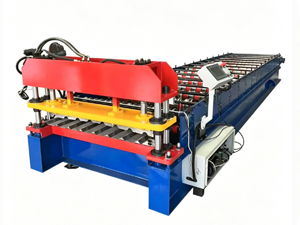
Double Layer Roll Forming Machine: Why Factories Choose Dual-Profile Lines for Cost-Effective Production
When a manufacturer wants to offer both a trapezoidal roof sheet and a corrugated wall panel, the traditional approach is two separate roll forming lines—one for each profile. That works, but it takes up floor space, requires double the operators, and multiplies the maintenance burden. A double layer roll forming machine solves this by combining two profile configurations into a single production line, and in many factory contexts, the economics are compelling.
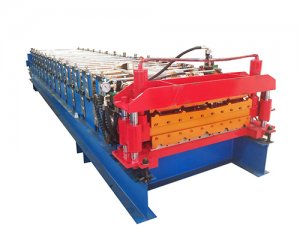
How a Double Layer Machine Works
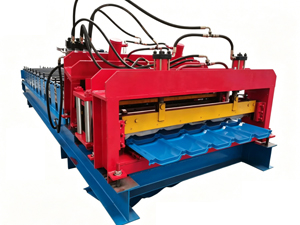
The concept is deceptively simple. Instead of one set of rollers, the machine has two forming sections stacked vertically. The steel strip passes through the lower section, producing one profile, and simultaneously through the upper section producing a different profile. In practice, most double layer lines are arranged so that one profile emerges from the top and the other from the bottom, both fed from the same decoiler and synchronized by a common PLC control system.
The key mechanical challenge is keeping the two forming paths independent enough that changes to one profile do not affect the other, while sharing common infrastructure like the decoiler, the electrical cabinet, and the control interface. Well-designed machines from established manufacturers handle this cleanly. Machines from less experienced builders tend to have cross-talk between the two paths that causes quality problems under load.
Who Benefits Most from a Double Layer Machine
Small to medium-sized factories that serve diverse customer requirements get the most value from double layer equipment. A factory receiving orders for both 820mm corrugated roof sheets and 1000mm ribbed wall panels from the same project developer can produce both on one line without dedicating floor space to separate machines.
Contractors working on large-scale projects with mixed roof and wall specifications also benefit. Being able to switch between profiles on the same shift means a smaller factory can bid on more varied contracts without turning work away or subcontracting profile production.
Manufacturers in developing regions where transport costs make it expensive to source profiles from specialist factories are particularly well-served. A local manufacturer with a double layer machine can supply a wider range of profile types to nearby construction projects, reducing lead times and transport costs.
Production Capacity: What to Expect
A well-maintained double layer roll forming machine typically produces between 10 and 30 meters of finished profile per minute per layer, depending on material thickness and profile complexity. In an eight-hour shift, that translates to roughly 4,800 to 14,400 linear meters of finished product per layer per day. Combined output from both layers can reach 20 to 30 tonnes per shift on lighter gauges.
Actual throughput depends heavily on changeover frequency. Switching between profiles on a double layer machine involves physically swapping the roller cassette for the relevant layer, which typically takes 30 minutes to 2 hours depending on the machine design and whether quick-change cassettes are available. Factories that plan their production schedules to minimize changeovers—batching orders for the same profile together—achieve significantly higher overall output.
The Cost Equation: Two Machines vs. One Double Layer
A single-profile roll forming machine from a reputable manufacturer typically costs $12,000 to $30,000 depending on profile width and capacity. Two such machines cost $24,000 to $60,000 plus the cost of additional floor space, wiring, and air supply infrastructure. A comparable double layer machine costs $30,000 to $55,000—a significant saving on equipment alone, before factoring in the space and utility savings.
The operational cost comparison is similar. Two machines require two operators, two sets of spare rollers, and two maintenance schedules. One double layer machine consolidates all of that. For a factory running two shifts, consolidating to a single machine can save the salary of one operator over a full year.
Limitations and When Not to Choose a Double Layer Machine
Double layer machines are not the right choice for every factory. High-volume production of a single profile is better served by a dedicated single-layer machine designed for that profile at maximum speed. A double layer machine shares the drive motor between the two layers, which can limit the top speed of each layer compared to a dedicated machine with its own motor.
Profile compatibility is another consideration. The two layers of a double layer machine must use the same material gauge range. If your factory needs to produce both thin 0.4mm wall panels and heavy 1.2mm structural roof sheets, you need two machines rather than a double layer line. Similarly, very wide panels—over 1,000mm—may not fit the forming geometry of a standard double layer machine.
Sourcing from Manufacturers: What to Clarify Upfront
When evaluating double layer machines from different manufacturers and suppliers, confirm the following before committing:
The roller cassette system: are the upper and lower roller sets on independent cassettes that can be swapped without dismantling the frame? Quick-change systems add to the machine price but pay back quickly in reduced downtime.
The control system: what PLC brand is used, and is the programming documented in English? Proprietary systems with undocumented code are a liability.
Warranty scope: what is covered, for how long, and what does the manufacturer actually do when you report a fault? A written warranty backed by a responsive technical support team is worth more than a long warranty from a supplier who takes weeks to respond to emails.
Spare parts availability: how long does it take to get replacement rollers, hydraulic seals, and electrical components? A machine that is down for three weeks waiting for a replacement roller is a production disaster that the warranty will not fix.
Bottom Line
For factories that need to produce two distinct roof or wall profiles without doubling their equipment footprint, a double layer roll forming machine is a well-proven solution. The capital cost advantage over two dedicated machines is real, and the operational consolidation—fewer operators, simplified maintenance, less floor space—reinforces the case. As with any production equipment purchase, the critical variables are the quality of the machine itself, the responsiveness of the manufacturer or supplier, and how well the machine's profile range matches your actual order book.
References
Material Handling Institute. Roll Forming Equipment Selection and Production Planning. MHI Technical Report Series, 2019.
Fabricators and Manufacturers Association International. Metal Forming: Machinery and Equipment Standards. FMA, 2021.
European Coil Processing Association. Best Practices for Multi-Profile Roll Forming Operations. ECPA Guidelines No. 7, 2018.
International Association of Steel Producers. Operational Efficiency in Cold Roll Forming Plants. IASP Technical Bulletin, 2020.
Society of Manufacturing Engineers. Equipment ROI Analysis for Metal Forming Operations. SME Research Division, 2022.
This article is intended for manufacturers, factory managers, and industry professionals researching roll forming equipment investments.






 首页
首页 产品
产品 联系
联系
