

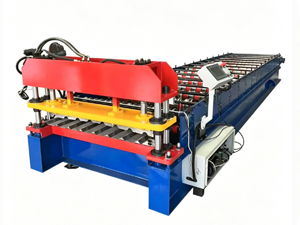
Floor Deck Roll Forming Machine: How Manufacturers Build Composite Steel Floor Panels for Construction
Composite steel floor decks are one of those structural components that, once installed, spend the rest of their service life completely hidden inside a building—under concrete, behind ceilings, buried in floors. Yet the engineering they perform is critical. A floor deck roll forming machine is the equipment that produces these panels, and if you are involved in sourcing or specifying them, understanding how they are made helps you make better decisions.
The Role of Steel Floor Deck in Buildings
Floor deck panels serve two purposes simultaneously. During construction, they act as a working platform and formwork for the wet concrete slab above. They carry the weight of workers, concrete, and construction loads without the need for additional scaffolding or support. Once the concrete has cured and the composite action develops between steel and concrete, the deck also acts as tensile reinforcement for the slab.
The composite action is achieved through embossments pressed into the deck profile during the roll forming process. These raised patterns in the steel surface grip the concrete and transfer shear forces between the two materials. Without well-formed embossments, the deck and concrete act independently, which defeats the purpose of the composite system.
The Profile Geometry of Floor Deck Panels
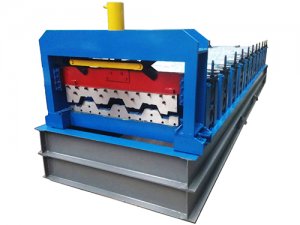
Most floor deck profiles fall into three categories: dovetail, trapezoidal, and re-entrant. The dovetail profile—named for its tapered notch shape—has been the standard in North American composite floor construction for decades. It interlocks with the concrete slab in a way that provides excellent shear transfer and reduces the risk of longitudinal cracking.
Trapezoidal deck profiles are common in European and Asian markets. They are simpler to roll form and provide good spanning capability, though the composite action depends more on mechanical shear connectors welded to the deck than on the profile geometry alone. Re-entrant profiles are less common but appear in some specialized applications where slab depth is constrained.
The typical deck panel width is 600mm to 915mm after forming, and lengths are cut to order up to 12 meters or more depending on the project specification. Material thickness for structural deck typically ranges from 0.75mm to 1.5mm galvanized steel.
How a Floor Deck Roll Forming Machine Is Built
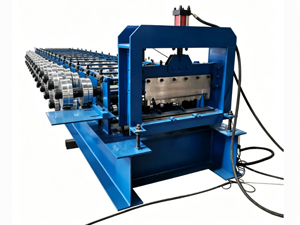
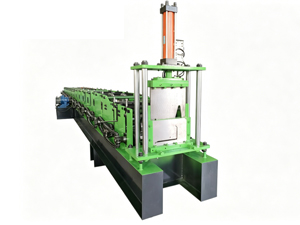
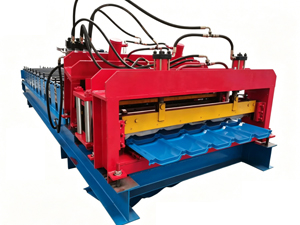
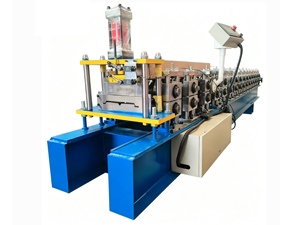
A floor deck roll forming line needs to handle thicker material than a typical roof panel line. The rollers and shafts are heavier, the motor power is higher, and the forming process requires more precise control to achieve the tight dimensional tolerances needed for structural applications.
The embossing station is the distinguishing feature of a floor deck machine. It uses specially profiled rollers with raised patterns that press into the web of the deck panel during forming. The embossing rollers wear faster than standard forming rollers because they are punching into harder material, and they require more frequent replacement in high-volume production environments.
The cutting system on most deck machines is a hydraulic shear, though some high-capacity lines use a flying saw for faster cutting on thick material. The cut accuracy matters for structural applications where deck panels must meet specific lengths to align with structural steel beam positions.
Material and Quality Requirements
Structural floor deck is almost always hot-dip galvanized steel, typically to a zinc coating mass of Z275 (275g/m2 total both sides). Some specifications require Z450 or even Z600 for aggressive environments. The zinc coating protects the steel from corrosion during storage, handling, and the period before the concrete slab is poured.
Quality standards for floor deck are set by national building codes and industry associations. In the United States, SDI (Steel Deck Institute) publishes design manuals and quality standards. In Europe, EN 1090 governs execution. Factories supplying deck to projects governed by these standards need to demonstrate compliance through material certifications, dimension checks, and in some cases third-party inspection.
What a Manufacturer or Factory Buyer Needs to Know
When sourcing a floor deck roll forming machine from a manufacturer, the most important technical questions are about embossing quality and dimensional tolerances. Request sample panels from the manufacturer before purchase—ideally from a machine running the exact profile you intend to buy. Measure the embossment depth, the panel depth, the cover width, and the flat flange dimensions against the specification. Any significant deviation suggests the machine is not optimized for your target profile.
Ask the manufacturer about roller lead times and costs. Embossing rollers for thick structural deck are expensive and have a shorter life than standard forming rollers. A supplier who quotes a low machine price but charges premium rates for replacement embossing rollers will cost you more over the life of the equipment.
Confirm the machine's capacity for the material thickness and grade you intend to run. A machine rated for 0.75mm to 1.0mm may struggle with 1.2mm or 1.5mm material, producing bowed panels, excessive roller wear, or motor overload trips. Always match the machine specification to the heaviest material in your production range, not just the most common.
The Business Case for Floor Deck Production
Floors are one of the largest cost components in multi-story commercial and industrial construction. Developers and contractors are under constant pressure to reduce floor construction costs and construction schedules. Steel floor deck that arrives on site pre-cut to length, properly certified, and ready to install offers clear advantages over on-site formed or cast systems.
For a factory considering adding floor deck production to its range, the market fundamentals are favorable in regions with active commercial construction. The key is having a machine that can produce panels meeting the structural specifications that engineers require—and a manufacturer or supplier who can support that quality consistently over years of production.
References
Steel Deck Institute. Design Manual for Composite Decks, Form Decks, and Roof Decks. SDI Publication DM-2, 2021.
American Institute of Steel Construction. Steel Construction Manual, 15th Edition. AISC, 2023.
European Committee for Standardization. EN 1090-1: Execution of Steel Structures and Aluminium Structures — Requirements for Conformity Assessment of Structural Components. CEN, 2018.
British Standards Institution. BS 5950-4: Structural Use of Steelwork in Building — Code of Practice for Installed Fire Protection. BSI, 2010.
National Association of Steel Bridge Fabricators. Composite Floor Deck Installation Guidelines. NASBF Technical Note, 2019.
This article is intended for construction industry professionals, engineers, and procurement teams seeking information about floor deck production equipment.






 首页
首页 产品
产品 联系
联系
