

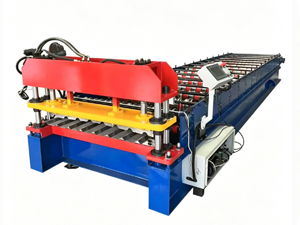
Glazed Tile Roll Forming Machine vs. Traditional Roofing: Why Manufacturers Prefer Steel Tile Profiles
There is a reason you see steel roof tiles on more buildings every year. The economics have shifted. A glazed tile roll forming machine allows factories to produce steel panels with the visual profile of traditional clay or concrete tiles, at a fraction of the weight, with better weather resistance, and at production speeds that would have seemed impossible when those traditional tiles were invented. This article compares the two approaches and explains the technical basis for the shift.
What Makes a Glazed Tile Profile Different
A steel glazed tile is not a flat sheet. The roll forming process shapes it into a tile-like profile—typically with a curved or stepped surface, ribbed valleys, and a lapping system that mimics the way clay tiles overlap when installed. The result looks convincingly like traditional tiling from a distance but is actually a light-gauge cold-formed steel panel, usually 0.3mm to 0.6mm thick.
The "glazed" part comes from the pre-painted or pre-coated steel coil that goes into the machine. Manufacturers use color-coated steel with a glossy or matte paint finish that mimics the appearance of glazed clay tiles. The paint systems used by quality manufacturers include primer, top coat, and clear coat layers that provide UV resistance and color retention for 15 to 25 years depending on the climate.
Weight: The Most Significant Practical Difference
A clay plain tile weighs approximately 65 to 75 kg per square meter. A concrete tile runs 40 to 55 kg per square meter. A steel glazed tile of equivalent coverage weighs 4 to 8 kg per square meter. That is a factor of ten difference. The structural implications are substantial: lighter roof tiles mean lighter roof structures, which means lighter walls, lighter foundations, and ultimately a less expensive building.
In seismic zones, the weight reduction is not just an economic benefit—it is a safety one. Buildings with lighter roofs perform better in earthquakes because there is less mass to accelerate and decelerate during ground motion. Engineers in Japan, New Zealand, and parts of the United States have increasingly specified steel tile roofs in seismic areas for this reason.
How Glazed Tile Roll Forming Machines Work
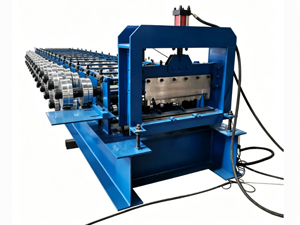
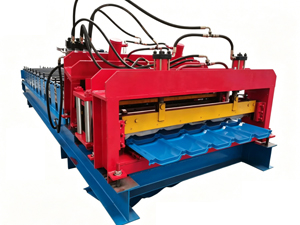
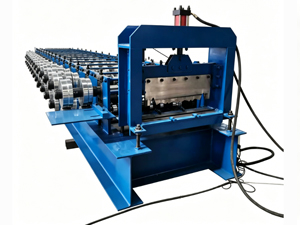
The machine uses a tile-pattern roller set that forms the distinctive curved and stepped surface of the tile profile. The forming sequence is more complex than a standard trapezoidal roof sheet because the tile profile has more geometry per unit length. Most tile machines run at slower speeds than plain roof sheet machines—typically 5 to 15 meters per minute—because the tighter bends in the profile require more gradual forming to avoid cracking the paint surface.
The machine also needs a pressing station that embosses or stamps the tile pattern into the flat areas of the profile between ribs. This is done by a mechanical or hydraulic press integrated into the roll forming line. The quality of this pressing step—depth of embossment, surface finish, absence of cracking—directly affects the appearance of the finished tile.
Speed and Cost: The Factory Perspective
Traditional clay tile production involves molding, drying, and firing—a batch process that takes days from raw material to finished tile. Concrete tiles are pressed and cured, which is faster but still batch-based. Roll forming is a continuous process: a coil of steel goes in one end, finished tiles come out the other. A single operator can manage a tile roll forming line producing 2,000 to 5,000 square meters of finished tile per shift.
The cost comparison reflects this. Producing steel tile by roll forming costs roughly $2 to $6 per square meter depending on material grade, profile complexity, and production volume. Clay tiles from a regional kiln can cost $8 to $20 per square meter before transport, and imported premium tiles can reach $40 per square meter. The savings for a factory or developer sourcing steel tile are obvious.
Durability and Weather Performance
Quality steel glazed tiles from a well-run factory carry 20 to 30-year paint warranties from the coil supplier. In practice, steel tile roofs installed in non-coastal environments commonly last 30 years or more with minimal maintenance. The limiting factor is usually the paint system, which can show chalking and color fade after 15 to 20 years in harsh sun conditions.
Clay tiles are more durable in terms of surface appearance but more fragile in terms of impact resistance. A clay tile cracked by a falling branch or a foot slip during maintenance can admit water into the structure. Steel tile, being flexible, is more resistant to impact damage and can be walked on more safely during maintenance. The tradeoff is that once a steel tile's coating is damaged down to the bare steel, it will corrode if not touched up promptly.
Where Traditional Tiles Still Have an Edge
There are contexts where traditional clay or concrete tiles remain preferable. In heritage conservation contexts, planning authorities in many countries mandate traditional roofing materials to preserve the visual character of historic areas. Some architectural styles—Mediterranean vernacular, certain East Asian traditional forms—work better with clay tiles that have the irregular surface and color variation that steel tiles, however well printed, cannot fully replicate.
Coastal and marine environments present another challenge. Salt air accelerates corrosion of cut edges on steel tile, even with galvanized and painted coatings. In these environments, clay tiles are often the more durable choice despite their weight and cost disadvantages.
What to Look for in a Glazed Tile Machine Manufacturer
The tile embossing station is the most critical and most often poorly executed component of a glazed tile roll forming machine. Before purchasing, ask the manufacturer for tiles produced on a running machine and inspect them closely under raking light. Any visible cracking, uneven embossing depth, or surface ripple will be visible on the installed roof and will damage the reputation of whoever sells it.
The paint system compatibility also matters. Not all paint finishes on pre-painted coil are suitable for tight-radius tile embossing. High-gloss finishes are particularly prone to micro-cracking at tight bends. Ask the coil supplier and the machine manufacturer to confirm that the paint system you intend to use is compatible with the forming process. This is a conversation that should happen before you order the machine, not after it arrives.
References
National Roofing Contractors Association. Metal Roofing: Design Criteria and Installation Standards. NRCA Publications, 2020.
Australian Institute of Architects. Roofing Materials for Heritage Buildings: Technical Guidance Note. AIA, 2018.
British Standards Institution. BS 5427-1: Code of Practice for the Design and Installation of Roofs with Metallic Sheet coverings. BSI, 2016.
American Society of Testing and Materials. ASTM A792/A792M: Standard Specification for Steel Sheet, 55% Aluminum-Zinc Alloy-Coated by the Hot-Dip Process. ASTM, 2021.
Building Research Establishment. Comparative Life Cycle Assessment of Clay Tile vs. Steel Tile Roofing Systems. BRE Report BR 513, 2019.
This article is for informational purposes for construction professionals and manufacturers evaluating roof tile production options.






 首页
首页 产品
产品 联系
联系
