

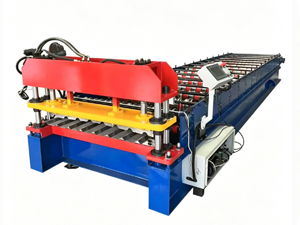
Hydraulic Uncoiler for Roll Forming Lines: What Factories Need to Know Before Buying
The uncoiler is the unglamorous workhorse of a roll forming line. It sits at the input end of the machine, holds the coil, and feeds steel strip into the rollers at a controlled tension. If the uncoiler does not work properly, the whole line suffers: material wanders, edges get damaged, the coil chokes and stops, and the operator spends half the shift wrestling with a misbehaving decoiler instead of producing good parts. This article explains what factories should know before buying one.
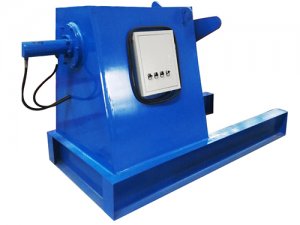
Manual vs. Hydraulic vs. Motor-Driven Uncoilers
The simplest uncoiler is a manual or gravity-expansion model where the operator physically expands the coil arbor, slides the coil onto the mandrel, and sets the coil clamp. This works for small coils and low-volume production, but it is slow, requires the operator to work in the coil area during each coil change, and provides no tension control.
A hydraulic uncoiler uses hydraulic cylinders to expand and contract the coil mandrel and typically includes a hold-down arm to keep the coil from lifting as it unwinds. This is the most common configuration for mid-range roll forming equipment. Hydraulic uncoilers are faster to load, require less operator effort, and provide some resistance against the strip pulling from the coil, which reduces the tendency of thin material to snake and wander.
Motor-driven uncoilers (sometimes called active uncoilers or payoff reels) add an electric motor that provides active feeding tension. The motor can be set to maintain a constant strip tension regardless of the coil diameter, which is particularly valuable for pre-painted or thin-gauge material where inconsistent tension causes surface scratches or material stretch. Motor-driven uncoilers are more expensive but reduce scrap rates significantly on sensitive materials.
Capacity Specifications: What the Numbers Mean
Uncoiler capacity is defined by three parameters: maximum coil weight, maximum coil width, and maximum coil inner diameter (coil ID) and outer diameter (coil OD). These must all match the coils you intend to run.
Maximum coil weight: typically 5 to 15 tonnes for standard uncoilers. Heavier coils require heavier-duty decoilers with larger bearing assemblies and stronger hydraulic systems. Always check whether the machine rating is for the structural capacity or the practical working load—the two can differ by 20 to 30 percent.
Maximum coil width: the width of the widest coil the machine can accommodate from edge to edge. Standard widths are 600mm, 760mm, 920mm, 1000mm, 1250mm, and 1500mm. A machine rated for 1000mm width cannot handle a 1250mm coil.
Coil inner diameter: most uncoilers are designed for standard IDs of 508mm (20 inches) or 610mm (24 inches). Some models are adjustable or can be fitted with adaptor rings for non-standard IDs. Always confirm this matches the coils you purchase.
Coil outer diameter: determines how much material the machine can hold before requiring a coil change. Larger OD coils mean fewer changeovers, which is valuable in high-volume production.
Tension and Loop Control
The uncoiler's most important function is maintaining consistent strip tension as the coil unwinds. As the coil diameter decreases during a run, the same linear meters per minute means the coil must rotate faster. Without proper tension control, the strip can go slack, loop, and jam the line, or it can pull too hard and stretch or tear the material.
Hydraulic uncoilers use a hold-down arm with a spring or hydraulic counterweight to provide resistance as the coil diameter shrinks. The key adjustment is the arm pressure: too much pressure and the strip stretches; too little and it goes slack. Operators learn the correct setting for each material type and coil weight over time.
For quality-critical production—pre-painted coils, very thin material, or aluminum—an active motor-driven uncoiler with a tension controller is worth the additional cost. The investment pays back quickly in reduced material waste and fewer line stoppages.
Loading and Changeover Time
In factories running multiple coil changes per shift, the time it takes to load a new coil directly affects output. Hydraulic uncoilers with quick-change mandrel systems can complete a coil change in 5 to 10 minutes. Manual or older-style uncoilers can take 20 to 30 minutes for the same change.
When evaluating uncoilers from different manufacturers, ask about the changeover procedure and time. A machine that is mechanically capable but requires a complicated sequence of steps to change a coil will sit idle more than its specifications suggest.
What to Ask a Supplier
Before purchasing, confirm the uncoiler's maximum working width and weight match your largest coils. Ask about the expansion range of the mandrel—some uncoilers have limited adjustment that may not fit all your coil IDs. Check the hydraulic system pressure and whether it is compatible with your existing roll former's hydraulic supply, if they are to be integrated.
Enquire about the availability of spare mandrel segments and hold-down arms. These wear items should be in stock from the manufacturer or available within a reasonable lead time. A machine that requires a 12-week lead time for a replacement mandrel is not a good purchase regardless of its price.
Integration with the Main Roll Forming Line
In many factories, the uncoiler and the main roll forming machine are purchased as separate units from potentially different suppliers. This is fine, but it requires careful attention to integration. The uncoiler must supply strip at the correct height, alignment, and tension for the entry guide of the roll former. Misalignment at this point causes edge damage, wandering, and increased roller wear.
A reputable manufacturer will provide clear dimensional drawings showing the entry height, strip centerline, and recommended mounting position relative to the roll former. If the supplier cannot or will not provide this information, it is a warning sign about the depth of their technical support.
Getting the Right Uncoiler for Your Line
For most roll forming factories, a hydraulic uncoiler with a 10-tonne capacity, adjustable for standard coil widths up to 1,250mm, represents a solid general-purpose choice. If your production runs pre-painted material or thin gauges below 0.5mm, seriously consider a motor-driven model with tension control—the reduction in surface defects alone justifies the cost premium.
The factories and suppliers that have been supplying roll forming equipment for decades understand that the uncoiler is not an afterthought. A well-chosen uncoiler matched to your actual production requirements will quietly improve the performance of the entire line, day after day, without demanding attention.
References
Material Handling Institute. Coil Handling Equipment: Selection and Safety Guidelines. MHI, 2019.
National Coil Processing Association. Technical Guidelines for Uncoiler and Leveler Integration in Roll Forming Lines. NCPA, 2018.
American Society of Mechanical Engineers. ASME B30.20: Below-the-Hook Lifting Devices. ASME, 2021.
International Organization for Standardization. ISO 12492:2012 Steel Products — Coil Processing Terminology. ISO, 2012.
European Coil Processing Association. Best Practices for Coil Storage, Handling, and Processing. ECPA Publication, 2020.
This article is for factory managers, equipment buyers, and production engineers researching decoiler and coil handling equipment for roll forming operations.






 首页
首页 产品
产品 联系
联系
