

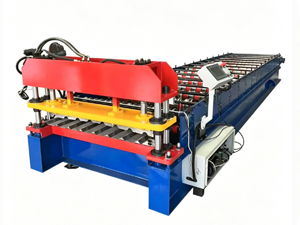
How to Choose a Reliable Roll Forming Machine Manufacturer
Buying a roll forming machine is not a catalogue purchase—it is a multi-year production decision. The sheet metal profiles you ship next year, the downtime you absorb, and the spare parts you can source at short notice all trace back to one choice: the roll forming machine manufacturer you partner with.
Price is the easiest variable to compare and the worst one to decide on. A machine that forms the wrong tolerance, ships without proper engineering drawings, or cannot get a replacement roller within a reasonable lead time will cost far more than the upfront saving. This guide walks through the verification checklist used by engineering teams when qualifying equipment suppliers.
Why the Manufacturer Matters More Than the Quotation
A roll forming line is a system: decoiler, feeding guide, roll stations, shear or punch, PLC control, and run-out table. Each subsystem has to be tuned to the specific steel grade and profile. A manufacturer that only sells a generic frame will struggle when your material is galvanized, pre-painted, or slightly out of spec.
When you evaluate a roll forming machine manufacturer, you are really buying three things: process knowledge (the ability to predict springback and edge wave before cutting steel), build quality (the tolerances held in the rollers, shafts, and frame), and continuity (the spare parts, drawings, and support that keep the line running in year four).
Certifications and Factory Audits
Start with the paperwork, then verify it. A serious manufacturer should be able to present ISO 9001 for quality management (ask for the valid certificate number, not a faded scan), CE marking where the machine is destined for Europe, plus the related machinery directive documentation, and third-party inspection options (SGS, TÜV, or BV) at the factory before shipment.
A factory audit—even a remote video walkthrough—tells you more than a brochure. Look for a dedicated machining workshop (CNC for rollers), a calibration log for measuring tools, and an assembly area where wiring is routed, not taped. If the supplier hesitates to show the shop floor, treat that as a signal.
Engineering Capability: From Profile to Tooling
The strongest differentiator between a trading company and a true roll forming machine manufacturer is engineering depth. Before ordering, request a flower diagram or pass schedule showing each station's incremental bend, a confirmed raw material spec (yield strength, coating, and thickness range), and a sample profile drawing with tolerances you can hand to your own QC team.
A capable supplier will ask you questions first: coil width, inner diameter of your decoiler, required daily output, and local power supply. That interrogation is a good sign. It means they are designing around your plant, not pushing stock inventory.
Roller and Shaft Specs That Signal Real Quality
The rollers do the actual forming, so their material and hardness decide both surface finish and service life. A manufacturer that cannot state these numbers clearly is guessing.
GCr15 (equivalent to 52100 bearing steel) with a surface hardness of HRC58–62 resists wear far better than untreated carbon steel. Pair that with shafts of Ø70–90 mm and you get the rigidity needed to hold profile tolerances at speed. If your coil yield reaches 350 MPa—common with high-tensile structural sections—confirm the frame and rollers are rated for it.
Entry-level builds typically use 45# steel with chrome plating at ~HRC45 on Ø50–60 mm shafts, running 6–10 m/min on 0.3–0.6 mm thickness and ≤ 235 MPa yield. Standard builds upgrade to GCr15 at HRC58–62 on Ø70–90 mm shafts, 8–15 m/min, 0.3–0.8 mm, and ≤ 350 MPa. Heavy-duty builds add heat-treated GCr15 with matching high-speed capacity.
PLC, Control, and Operator Safety
The control system is where modern lines live or die. A reputable roll forming machine manufacturer will offer a named PLC rather than an unbranded controller. Look for Siemens or Delta PLC with touchscreen HMI, length control via encoder (not a mechanical counter), adjustable speed in the 8–15 m/min range with soft start/stop, and safety interlocks on the shear and access doors.
Ask for the I/O list and a backup of the program on a USB stick. If the supplier cannot hand you the logic, you are locked to them for every future tweak.
Spare Parts, Tooling, and Lead Times
Downtime is the real tax on a cheap machine. Before signing, agree on a spare-parts package and a clear lead time for replacements: two sets of forming rollers per profile (or at least the most worn station rollers), a spare shear blade and punch die, seals, bearings, and the specific hydraulic cartridge valves used, and named freight forwarder with realistic days-to-door, not vague delivery promises.
A reliable roof forming machine supplier will keep your roller drawings on file and quote a replacement roller in working days, not months. Confirm whether rollers are interchangeable between your future machines—standardizing on one manufacturer pays off here.
After-Sales and Remote Support
No machine ships perfect for every coil lot. What separates partners from vendors is response. Look for remote diagnostics over the PLC or a video call within 24 hours, clear numbered wiring diagrams and a parts manual in English, training (either on-site commissioning or a recorded run-through for your operators), and availability of the original engineer who built your line, not a rotating call center.
How to Evaluate a Supplier's References
Ask for three references in your region or industry, then actually call them. Good questions: How long from deposit to loaded container? Did the first trial run meet the profile tolerance? When did you last need a spare part, and how fast did it arrive? Would you buy from them again?
A manufacturer with nothing to hide will volunteer a visit to an existing customer's factory. That single trip tells you more than any sales deck.
Red Flags to Avoid
Quotes that change the roller material after you ask about hardness.
Refusal to share the flower diagram or profile drawing.
"CE" claimed with no directive paperwork.
No named PLC, just "imported control system."
Pressure to pay the full balance before a pre-shipment inspection.
FAQ
What certifications should a roll forming machine manufacturer have? At minimum, ISO 9001 for process control and CE where the machine enters the EU. Ask for valid certificate numbers and the machinery directive file. Third-party pre-shipment inspection (SGS/TÜV/BV) is worth the fee on a first order.
How do I verify a supplier's references? Request three regional references and call them. Ask about lead time, first-run tolerance, spare-part speed, and repeat-purchase intent. A confident manufacturer will also offer a visit to a running line.
What spare parts should I stock for a roll forming line? Keep a spare shear blade, the wear-prone station rollers, bearings and seals, and the hydraulic cartridge valves. Agree on the replacement lead time in writing before you pay the balance.
How long does a typical roll forming machine last? With GCr15 rollers at HRC58–62 and proper maintenance, a well-built line runs 8–12 years in two-shift production. The limiting factor is usually roller wear on abrasive or thick coatings, not the frame.
Conclusion
Choosing a roll forming machine manufacturer comes down to verifiable engineering, honest specs, and support you can reach when you need it. Use the checklist above—certifications, roller material, shaft diameter, named PLC, spare-part lead time, and real references—and the decision gets far less risky.
If you are gathering quotes, Tianyu is one option worth including in your comparison: our lines are built on GCr15 rollers (HRC58–62), Ø70–90 mm shafts, Siemens or Delta PLCs, and rated for steel up to 350 MPa yield. Send us your profile drawing and coil spec, and we will return a pass schedule and a realistic lead time—no guesswork.
Sources: ISO 9001:2015 Quality Management Systems — Requirements (International Organization for Standardization); EU Machinery Directive 2006/42/EC; ASME (American Society of Mechanical Engineers) B18.5.2.1M for dimensional standards on formed profiles; SGS Group Pre-Shipment Inspection Protocols for Capital Equipment.






 首页
首页 产品
产品 联系
联系
