

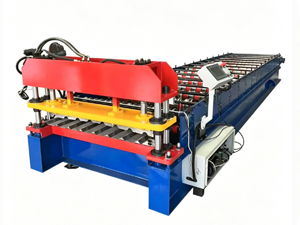
Standing Seam Roll Forming Machine: Metal Roofing Systems and Factory Production Guide
Standing seam metal roofs have become synonymous with contemporary commercial architecture. The clean lines, concealed fasteners, and durable performance of these systems appear on office buildings, retail centers, industrial facilities, and increasingly on high-end residential construction worldwide. Behind every standing seam roof is a manufacturing process—and a roll forming machine—that transforms coiled steel into the interlocking panels that protect those buildings. This article examines how standing seam roll forming machines operate, what specifications matter for different building applications, and how factories can establish themselves as reliable suppliers to the metal roofing market.
Understanding Standing Seam Panel Geometry
A standing seam panel derives its name from the vertical leg seam that rises above the flat pan of the panel. This seam serves dual purposes: it creates a weatherproof joint between adjacent panels, and it provides structural continuity that helps the roof system resist wind uplift forces.
The two dominant seam types—snap-lock and mechanically seamed—differ in how the seam is formed during installation. Snap-lock seams have a specially shaped female rib that snaps over the male rib without specialized equipment, simplifying installation and reducing labor costs. Mechanically seamed panels require a portable seaming machine that folds the seam edges together, creating a tighter, higher-performance joint suitable for low-slope applications and high-wind environments.
Panel widths typically range from 300mm to 600mm, with narrower panels providing more seams (more structural connections) and wider panels reducing the number of joints but requiring stronger underlying structure. The rib height—measured from the pan to the top of the seam—typically ranges from 38mm to 75mm, with taller seams providing greater structural performance and water-carrying capacity.
How Standing Seam Roll Forming Machines Work
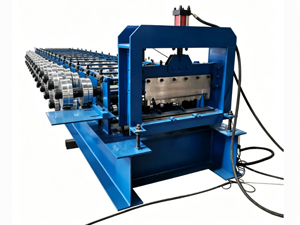
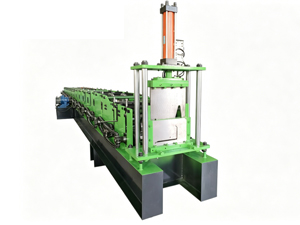
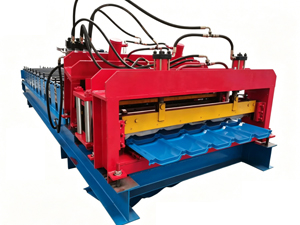
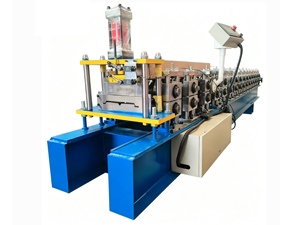
A standing seam roll forming machine must produce panels with precisely shaped ribs that will interlock correctly when installed. The forming process involves more complex roller geometries than simple trapezoidal roof sheets because the rib profiles incorporate under-locking bends and special return edges that create the interlocking feature.
The forming sequence typically involves 12 to 20 roller stations, depending on the complexity of the rib geometry and the material thickness. Each station incrementally shapes the flat strip into the final profile, with the final stations forming the interlocking rib edges that define the seam.
Panel length cutting occurs either at the machine exit using a shear or saw, or in a separate cutting station for very long panels that would be impractical to handle within the forming line. Some machines incorporate flying cut-off systems that cut panels to length without stopping the strip, enabling continuous high-speed production.
Material Specifications for Standing Seam Production
Standing seam roofs demand high-quality substrate and coating systems because the panels remain exposed to weather throughout their service life, often with minimal maintenance access. The material selection directly affects both the aesthetic appearance and the long-term durability of the installed roof.
Galvalume steel—steel coated with an aluminum-zinc alloy—provides the best combination of corrosion resistance and paint adhesion for most standing seam applications. The aluminum creates a stable oxide barrier while zinc provides sacrificial protection at cut edges and minor scratches.
Thickness range for standing seam panels typically spans 0.45mm to 0.70mm. Thinner material (0.45mm to 0.55mm) suits residential and light commercial applications with adequate structural support. Thicker material (0.60mm to 0.70mm) provides the stiffness and dent resistance required for commercial applications with larger spans and higher wind loads.
Pre-painted finishes from quality coil suppliers include multi-layer coating systems with primer, color top coat, and clear coat. These systems provide 25 to 40-year film integrity warranties and maintain color consistency across large roof areas better than field-applied coatings.
Seam Types and Their Performance Implications
The choice between snap-lock and mechanical seaming affects both the installation process and the ultimate performance of the roof system. Factories producing panels for both seam types need appropriate roller configurations for their machines, while specifying architects and roofing contractors should understand the implications for their specific project requirements.
Snap-lock systems offer faster installation because no seaming pass is required. The panel is simply clipped to the structural deck using concealed clips, and the adjacent panel snaps over the clip rib. This system works best on roofs with slopes of 3:12 or greater, where water drainage is rapid and standing water is unlikely.
Mechanical seaming creates a 90-degree or 180-degree double fold that provides superior weatherproofing and wind uplift resistance. These systems are specified for low-slope roofs (as low as 0.5:12 slope in some configurations), high-wind environments, and projects where the engineering specifies the enhanced performance that mechanically seamed seams provide.
Clip Systems and Thermal Movement Accommodation
Standing seam roofs are fundamentally designed as floating systems that accommodate thermal movement through the clip connections between panel and structure. Without this accommodation, panel expansion and contraction during temperature cycles would cause buckling, oil canning, or seam failure.
The clip system typically consists of a base plate that fastens to the structural deck and a top portion that engages the panel seam. Sliding clips allow horizontal movement along the panel length; fixed clips allow vertical movement (panel expansion upward). The engineering of clip spacing and placement determines how well the roof accommodates thermal movement without distress.
Factories supplying panels to projects with complex roof geometries—including curves, tapered sections, and transitions—should coordinate clip specifications with the roofing system engineer to ensure thermal accommodation is properly addressed at all conditions.
Factory Quality Control for Standing Seam Production
The tight tolerances required for standing seam panel interlocking demand systematic quality control throughout the production process. Panels that arrive at the job site out of tolerance cause installation delays and may require expensive replacement.
Critical dimensions to monitor include rib height consistency (typically ±0.5mm tolerance), seam edge angles that affect interlocking, panel width consistency across the length, and flatness of the pan section. Many factories implement in-line dimensional checks using laser measurement systems that flag deviations before out-of-tolerance material accumulates.
Surface inspection for coating defects—scratches, dents, edge burrs, and oil spots—prevents costly callbacks when finished roofs show blemishes that are difficult to repair without visible touch-up.
Export Considerations for Standing Seam Panel Factories
Standing seam panels present particular logistics challenges for export due to their length and the need to protect panel edges during transport. Standard shipping configurations include:
Bundle packaging with protective edge guards and interleaving paper between panels prevents surface damage during handling. Bundle weights typically target 1 to 2 tonnes for manual handling feasibility.
Container loading optimization maximizes utilization of 20-foot and 40-foot containers, though panel lengths may require specific container types or rack systems to prevent damage.
Panel lengths for container transport are typically limited to 6 meters for standard 20-foot containers, though some manufacturers offer extended lengths by diagonal loading or using open-top containers.
Climate-controlled storage at ports and job sites prevents moisture accumulation between panels that can cause surface staining, particularly with pre-painted products.
Market Positioning for Standing Seam Panel Manufacturers
The standing seam market rewards factories that combine consistent quality, technical competence, and reliable delivery. Architects and roofing contractors specifying these systems expect suppliers who understand the technical requirements and can provide engineering support for complex projects.
Building relationships with roofing contractors who install standing seam systems represents the most effective market entry strategy for new factories. These contractors influence material specification and can advocate for your panels to architects and developers based on field experience.
Technical documentation—installation guides, engineering load tables, thermal movement calculations, and warranty documentation—supports the specification process and differentiates professional factories from commodity suppliers.
References
Metal Construction Association. Standing Seam Roof Panel Performance Standards. MCA Tech Note 2019-1. MCA, 2019.
Sheet Metal and Air Conditioning Contractors National Association. Architectural Sheet Metal Manual. SMACNA, 7th Edition, 2018.
American Society of Civil Engineers. ASCE 7-22: Minimum Design Loads and Associated Criteria for Buildings and Other Structures. ASCE, 2022.
Cool Roof Rating Council. Solar Reflectance and Thermal Emittance Testing Protocols. CRRC-1. CRRC, 2021.
National Roofing Contractors Association. Metal Panel Roof Systems Manual. NRCA, 2022.






 首页
首页 产品
产品 联系
联系
